Schulterschmerzen
Begutachtet von Dr Colin Tidy, MRCGPZuletzt aktualisiert von Dr Philippa Vincent, MRCGPZuletzt aktualisiert 10. Aug 2023
Erfüllt die Anforderungen des Patienten Richtlinien des Patienten
- HerunterladenHerunterladen
- Teilen
- Language
- Diskussion
- Audio-Version
- Zu bevorzugten Quellen bei Google hinzufügen
Schulterschmerzen sind sehr häufig. Einige Ursachen von Schulterschmerzen lösen sich innerhalb weniger Wochen ohne Behandlung, abgesehen von einfachen Schmerzmitteln. Allerdings können einige Ursachen von Schulterschmerzen lange anhalten und weitere Tests und Behandlungen könnten erforderlich sein. Medizinische Hilfe sollte in Anspruch genommen werden, wenn die Schmerzen stark sind, nach einer Verletzung auftreten oder sich nach einigen Wochen nicht bessern.
Auf einen Blick
Schulterschmerzen sind häufig und haben viele Ursachen, einschließlich einer Schultersteife und Rotatorenmanschetten-Erkrankungen.
Ursachen können auch Probleme im Nacken, Osteoarthritis und verschiedene Verletzungen umfassen.
Schmerzen, die in der Schulter empfunden werden, können manchmal aus anderen Körperbereichen stammen.
Suchen Sie dringend einen Arzt auf, wenn der Schmerz stark ist, nach einer Verletzung auftritt oder die Schulter heiß oder rot ist.
Ärztliche Hilfe ist ebenfalls erforderlich, wenn der Schmerz beide Schultern betrifft oder sich mit Schmerzmitteln nicht bessert.
Erste Behandlungen können Schmerzmittel, Eispackungen und das Vermeiden von belastenden Aktivitäten umfassen.
Ursachen von Schulterschmerzen
See also the separate leaflet called Joint Pain. Shoulder pain is a common problem with a number of different causes which include (starting with the four most common):
Schultersteife
Schultersteife is sometimes called adhesive capsulitis of the shoulder. It is a condition where a shoulder becomes painful and stiff. Without treatment, symptoms usually settle but this may take up to 2-3 years.
Rotatorenmanschettenstörungen
The rotator cuff is a group of muscles and tendons that surround the shoulder joint and help to keep it stable. Rotatorenmanschettenstörungen are one of the most common causes of shoulder pain. Most people can be successfully treated and have complete recovery.
Pain coming from a problem in the neck.
Siehe die separaten Broschüren mit dem Titel Neck Pain und Whiplash Neck Sprain.
Acromioclavicular joint disorders
Some conditions (such as a shoulder injury or osteoarthritis) may affect the acromioclavicular joint, which is the joint at the top of the shoulder (see the diagram at the end of this leaflet). Problems with this joint are usually due to wear and tear of the joint or because of injury.
Osteoarthritis
Osteoarthritis due to general wear and tear in the shoulder joint is a very common cause of shoulder pain.
Septische Arthritis
Septische Arthritis is an infection in the joint. Symptoms include pain and tenderness over a joint, pain on moving the joint, and feeling unwell. Septic arthritis is uncommon but needs urgent hospital treatment.
Arthritis
Arthritis which affects a number of other different joints as well - eg, rheumatoide Arthritis - can cause shoulder pain, but would rarely cause shoulder pain on its own.
Polymyalgia rheumatica
Polymyalgia rheumatica is a condition which causes pain, stiffness and tenderness in large muscles, typically around the shoulders, upper arms and hips.
Injury (trauma):
A broken bone (fracture), such as a fracture of the upper arm bone (humerus) or a broken collarbone (clavicle) can cause shoulder pain.
Shoulder pain can be caused by a soft tissue injury such as an injury to a ligament, tendon or muscle around the shoulder joint. This may be caused in many different ways, such as a sports injury, a road traffic accident or a shoulder strain following heavy lifting or carrying.
Shoulder dislocation, where the ball of the joint has moved out of its socket, can cause severe shoulder pain. See the separate leaflet called Joint Dislocations.
Shoulder instability
The shoulder is unstable because the joint does not keep the bones close together. The humerus often 'pops out' of position.
Übertragener Schmerz
This is a pain which is felt in the shoulder due to the nerve pathways, but is actually caused by a problem elsewhere in the body. The neck is the most common source of referred pain. (See the links above for more information).
Occasionally pain may be felt in the shoulder when the source is the heart or the diaphragm (the muscle which separates the thorax - chest area - from the abdomen - tummy area. A problem within the abdomen can cause an irritation of the diaphragm which can sometimes be felt in the shoulder. Usually in these cases, there is pain in the abdomen or chest as well.
What causes shoulder pain?
How do I know what is causing my shoulder pain?
Some general guidelines which may help are as follows. However, remember there are always exceptions to every rule!
A shoulder pain usually - but not always - comes from a problem with the shoulder. It is more likely to be due to the shoulder itself if it hurts more when moving the shoulder, when touching the shoulder or if the shoulder looks abnormal, for example, if the shape looks different to the other side or if it is hot or red.
If the shoulder hurts when lifting the arm, it is likely to be due to a problem with the shoulder joint itself, such as a frozen shoulder, rotator cuff problem or shoulder injury.
If the pain started following a fall or injury of some type, it is likely that the trauma is causing the pain. A bone, joint, ligament, muscle or tendon may be damaged in some way.
Shoulder pain is very common and can affect all ages. Some causes of shoulder pain, such as osteoarthritis, frozen shoulder and rotator cuff disorders, mainly affect middle-aged and older people. Shoulder pain caused by sports injuries is more common in younger age groups. Sports that more commonly cause shoulder injuries include sports with repeated throwing or bowling, or contact sports such as rugby. Shoulder instability and acromioclavicular joint disorders often affect people who play regular sport.
If there are pains in other joints as well as the shoulder, it is more likely to be a generalised problem.
Pain and stiffness in both shoulders which is worse in the mornings or overnight may be due to Polymyalgia rheumatica.
Clues that suggest shoulder pain is coming from some other problem than the shoulder itself include:
If there is a blistery painful or itchy rash, it might be Gürtelrose.
If the shoulder pain is coming from the neck, there is likely to be some neck pain and/or stiffness as well.
If the pain is in the left shoulder, and if it comes with a pain or tightness in the chest, it may be coming from the heart. Usually with angina or a heart attack, there are other symptoms as well as or instead of shoulder pain. See the separate leaflets called Angina und Herzinfarkt (Myokardinfarkt) für Details.
If many joints are achy and if feeling hot one minute and cold the next, this may be due to a hohe Temperatur (Fieber) due to an infection - for example a Erkältung oder Grippe.
If there is tummy pain and pain at the tip of the shoulder blade, it might be coming from the liver or gall bladder in the abdomen.
If there is chest pain or shortness of breath or a persisting cough, with pain in the shoulder, it might be due to a problem with the lungs rather than the shoulder.
Should I see a doctor about shoulder pain?
Generally speaking:
It is sensible to seek medical attention urgently (straightaway) if:
The pain follows an injury or trauma and is a severe pain or the shoulder cannot be moved at all.
If the shoulder is hot to touch or red.
If there is chest pain or difficulty breathing or a feeling of being generally very unwell (call 999/112/911).
Medical attention should be sought soon if:
The pain is affecting both shoulders and is worse in the mornings or overnight.
The pain is not improving with simple painkillers for a couple of weeks.
The pain is affecting your daily activities.
There are other symptoms as well as shoulder pain, such as:
Bauchweh.
A persisting cough.
Nächtliches Schwitzen.
Gewichtsverlust.
A blistery rash.
There is a high temperature (fever) which is not responding to simple measures such as paracetamol, or if there is no obvious simple cause.
There is a past history of cancer and a persisting pain in the bone area of the shoulder.
There is new pain in more than one joint.
There is swelling of the shoulder.
How to relieve shoulder pain?
Initial treatment for some of the more common shoulder problems include:
Taking simple medicines for pain relief, such as Ibuprofen oder Paracetamol.
Ice packs can also be used to reduce or relieve pain.
Avoiding activities that may cause more pain in the shoulder, such as heavy lifting and carrying.
If these measures are not working, see a health professional.
Shoulder pain treatment
This will depend on the cause of the pain.
Treatments may include:
Physiotherapie
A physiotherapist might advise exercises, perform manipulation and/or recommend a steroid injection into your shoulder.
Überweisung
In some cases, a referral to a bone and joint specialist (orthopaedic specialist or rheumatology specialist) might be advised to see if any further treatment is required, such as a surgical operation to treat the cause of the shoulder pain. Surgery is not needed for most causes of shoulder pain.
Operation
In a few cases an operation may be required. Most commonly, this is done through a 'keyhole' procedure - an arthroscopy. During an arthroscopy, the parts of the shoulder joint can be examined to see what is the cause of the problem. Damaged tissues may be repaired or removed.
Decompression is one surgical option for shoulder tip (subacromial) pain. Decompressing means removing bone spurs and soft tissue through a thin telescope introduced through the keyhole cut. Evidence suggests that there is little value in this particular operation for pain for most people and this should be discussed during the decision-making process.
Occasionally, shoulder joints can be replaced with an artificial joint, particularly if the problem is wear and tear (osteoarthritis).
Medikamente
If the pain is thought to be due to inflammation, such as in rheumatoide Arthritis oder Polymyalgia rheumatica, then medicines are used. A rheumatologist is needed to prescribe drugs called disease-modifying-drugs for rheumatoid or other inflammatory arthritis. Steroids are usually used for polymyalgia rheumatica and these are usually prescribed in general practice. See the specific leaflets about these conditions for more information about treatment options.
Akupunktur
Recent evidence is that acupuncture may reduce shoulder pain but that more investigation into this is needed.
Shoulder pain tests
Investigations might be advised and these will depend on an initial examination to determine the most likely cause of the shoulder pain. Investigations may include:
Blood tests to look for underlying arthritis such as rheumatoid arthritis.
X-rays may be needed to diagnose a bone problem or joint problems.
An ultrasound scan may be needed to assess whether there is a problem with the soft tissues of the shoulder.
Referral might be needed for further investigations, such as an MRI scan. Specialists include:
A doctor specialising in bones and joints (an orthopaedic specialist).
A doctor specialising in diagnosis and treatment of arthritis and musculoskeletal conditions (a rheumatology specialist).
A physiotherapist.
Was ist das Ergebnis (Prognose)?
The outcome will depend on the underlying cause. Shoulder pain may only last for up to a few weeks, may last a few years or may be a lifelong problem. However, if the cause of the shoulder pain is diagnosed and treated early then this can often help to resolve or greatly reduce the pain in the shoulder.
The shoulder joint
Rotatorenmanschette
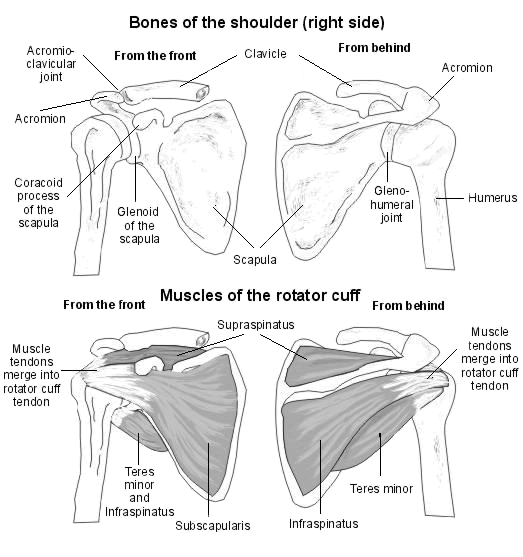
There are three bones in the shoulder region - the collarbone (clavicle), the shoulder blade (scapula) and the upper arm bone (humerus). The scapula is a triangular-shaped bone that has two important parts to it: the acromion and the glenoid. The three bones in the shoulder region form part of two main joints:
The acromioclavicular joint between the acromion of the scapula and the clavicle.
The glenohumeral joint between the glenoid of the scapula and the humerus.
There are also a number of muscles, ligaments and tendons around the shoulder. Ligaments are fibres that link bones together at a joint. Tendons are fibres that attach muscle to bone.
Patientenauswahl für Gelenkschmerzen

Knochen, Gelenke und Muskeln
Tennisarm
Tennisarm ist eine Erkrankung, bei der Schmerzen an der Außenseite des Ellenbogens auftreten. Sie wird häufig durch Überbeanspruchung verursacht, die Schäden an den Sehnen um den Ellenbogen herum verursacht. Bei vielen Menschen verbessern sich die Symptome im Laufe der Zeit, wenn sie Aktivitäten einstellen, die die Symptome auslösen. Studien haben noch nicht die beste Behandlungsmethode für Tennisarm bestätigt. Schmerzmittel können helfen, die Schmerzen zu lindern, bis sich die Erkrankung bessert. Eine Steroidinjektion kann kurzfristig die Schmerzen lindern. Allerdings kehren die Schmerzen oft zurück. Physiotherapie ist eine weitere Behandlungsmöglichkeit. Andere Behandlungen werden manchmal angewendet, wenn die Symptome anhalten.
von Dr. Philippa Vincent, MRCGP

Knochen, Gelenke und Muskeln
Luxation
Eine Luxation ist eine Verletzung, bei der die Knochen in einem Gelenk auseinander und aus ihren üblichen Positionen gezwungen werden. Um die Knochen eines großen Gelenks zu luxieren, ist normalerweise erhebliche Kraft erforderlich (obwohl es Ausnahmen gibt).
von Dr. Philippa Vincent, MRCGP
Häufig gestellte Fragen
Welche medizinischen Fachärzte behandeln Schulterschmerzen?
Je nach Ursache Ihrer Schulterschmerzen könnten Sie an einen Knochen- und Gelenkspezialisten (einen orthopädischen Spezialisten), einen Arzt, der sich auf Arthritis und muskuloskelettale Erkrankungen spezialisiert hat (einen Rheumatologen), oder einen Physiotherapeuten überwiesen werden.
Wie lange dauert die voraussichtliche Erholungszeit bei Schulterschmerzen?
Die Dauer von Schulterschmerzen variiert stark, abhängig von der zugrunde liegenden Ursache. Einige Arten von Schulterschmerzen können innerhalb weniger Wochen abklingen, während andere mehrere Jahre andauern oder sogar ein lebenslanges Problem sein können. Eine frühzeitige Diagnose und Behandlung kann oft helfen, die Schmerzen erheblich zu reduzieren oder zu beseitigen.
Kann Schulterschmerzen die täglichen Aktivitäten beeinträchtigen?
Ja, Schulterschmerzen können Ihre täglichen Aktivitäten erheblich beeinträchtigen. Wenn Sie feststellen, dass der Schmerz Ihre routinemäßigen Aufgaben stört, ist es ratsam, ärztlichen Rat einzuholen.
Könnte mein Schulterschmerz mit zugrunde liegenden Gesundheitszuständen verbunden sein?
Ja, Schulterschmerzen können manchmal ein Symptom für Erkrankungen an anderen Stellen im Körper sein. Wenn Sie zum Beispiel aktuell oder in der Vergangenheit Krebs hatten und anhaltende Schmerzen im Knochenbereich Ihrer Schulter verspüren, oder wenn Sie neue Schmerzen in mehreren Gelenken haben, könnten diese auf zugrunde liegende Gesundheitsprobleme hinweisen. Andere Symptome wie anhaltender Husten, Nachtschweiß oder unerklärlicher Gewichtsverlust zusammen mit Schulterschmerzen erfordern ebenfalls eine medizinische Untersuchung.
Was passiert während einer Schulterdekompressionsoperation?
Die Schulterdekompression ist eine chirurgische Option, die manchmal bei Schmerzen an der Schulterspitze in Betracht gezogen wird. Dabei werden Knochensporne und Weichgewebe mit einem dünnen Teleskop entfernt, das durch einen 'Schlüsselloch'-Schnitt eingeführt wird. Aktuelle Beweise deuten jedoch darauf hin, dass dieser spezifische Eingriff für die Schmerzlinderung bei den meisten Menschen nur begrenzten Wert hat, und dies sollte im Entscheidungsprozess für die Behandlung besprochen werden.
Können Schultergelenke durch ein künstliches Gelenk ersetzt werden?
Ja, in einigen Fällen können Schultergelenke durch ein künstliches Gelenk ersetzt werden. Dies wird insbesondere in Betracht gezogen, wenn das Problem auf erhebliche Abnutzung zurückzuführen ist, wie bei fortgeschrittener Arthrose.
Weiterführende Literatur und Referenzen
- Buchbinder R, Green S, Youd JM; Corticosteroid injections for shoulder pain. Cochrane Database Syst Rev. 2003;(1):CD004016.
- Green S, Buchbinder R, Hetrick S; Physiotherapy interventions for shoulder pain. Cochrane Database Syst Rev. 2003;(2):CD004258.
- Page MJ, Green S, Kramer S, et al; Manuelle Therapie und Übungen bei adhäsiver Kapsulitis (Frozen Shoulder). Cochrane Database Syst Rev. 2014 Aug 26;8:CD011275. doi: 10.1002/14651858.CD011275.
- Beard DJ, Rees JL, Cook JA, et al; Arthroscopic subacromial decompression for subacromial shoulder pain (CSAW): a multicentre, pragmatic, parallel group, placebo-controlled, three-group, randomised surgical trial. Lancet. 2018 Jan 27;391(10118):329-338. doi: 10.1016/S0140-6736(17)32457-1. Epub 2017 Nov 20.
- Artus M, Holt TA, Rees J; The painful shoulder: an update on assessment, treatment, and referral. Br J Gen Pract. 2014 Sep;64(626):e593-5. doi: 10.3399/bjgp14X681577.
- Schulterschmerzen; NICE CKS, November 2022 (nur für UK-Zugang)
- Ben-Arie E, Kao PY, Lee YC, et al; The Effectiveness of Acupuncture in the Treatment of Frozen Shoulder: A Systematic Review and Meta-Analysis. Evid Based Complement Alternat Med. 2020 Sep 25;2020:9790470. doi: 10.1155/2020/9790470. eCollection 2020.
Über den AutorVollständige Biografie anzeigen

Dr Philippa Vincent, MRCGP
Allgemeinmediziner, Medizinischer Autor
MB BS, Bsc, MRCGP (2000), DCH, DFSRH, DRCOG
Dr Philippa Vincent ist ein NHS-Arzt, der in Nordlondon arbeitet.
Über den RezensentenVollständige Biografie anzeigen

Dr Colin Tidy, MRCGP
Allgemeinmediziner, Medizinischer Autor
MBBS, MRCGP, MRCP (Paediatrics), DCH
Dr. Colin Tidy ist ein NHS-Arzt mit Sitz in Oxfordshire.
Artikelverlauf
Die Informationen auf dieser Seite wurden von qualifizierten Klinikern verfasst und begutachtet.
Artikel auch verfügbar in Englisch, Deutsch, Spanisch, Französisch, Italienisch, Portugiesisch, Hindi, Hebräisch, Arabisch, und Schwedisch.
Nächste Überprüfung fällig: 8. Aug. 2028
10. Aug 2023 | Neueste Version

Fragen, teilen, verbinden.
Durchsuchen Sie Diskussionen, stellen Sie Fragen und teilen Sie Erfahrungen zu Hunderten von Gesundheitsthemen.

Fühlen Sie sich unwohl?
Bewerten Sie Ihre Symptome online kostenlos
Abonnieren Sie den Patienten-Newsletter
Ihre wöchentliche Dosis klarer, vertrauenswürdiger Gesundheitsberatung - geschrieben, um Ihnen zu helfen, sich informiert, selbstbewusst und in Kontrolle zu fühlen.
Durch das Abonnieren akzeptieren Sie unsere Datenschutzrichtlinie. Sie können sich jederzeit abmelden. Wir verkaufen Ihre Daten niemals.
Mehr über Knochen, Gelenke und Muskeln
- Zervikale Spondylose
- Chondrocalcinose
- Antirheumatika, die den Krankheitsverlauf beeinflussen
- Luxation
- Ganglion
- Schmerzsyndrom des großen Rollhügels
- Hüftprobleme
- Hüftgelenkersatz
- Kniegelenkersatz
- Lupus
- Hammerfinger
- Meniskusrisse
- Mittelfußfrakturen
- Nackenschmerzen
- Olekranon-Bursitis
- Beckenbrüche
- Ameisenlaufen
- Polymyalgia rheumatica
- Rotatorenmanschettenverletzungen und -erkrankungen
- Wirbelscheibenprobleme