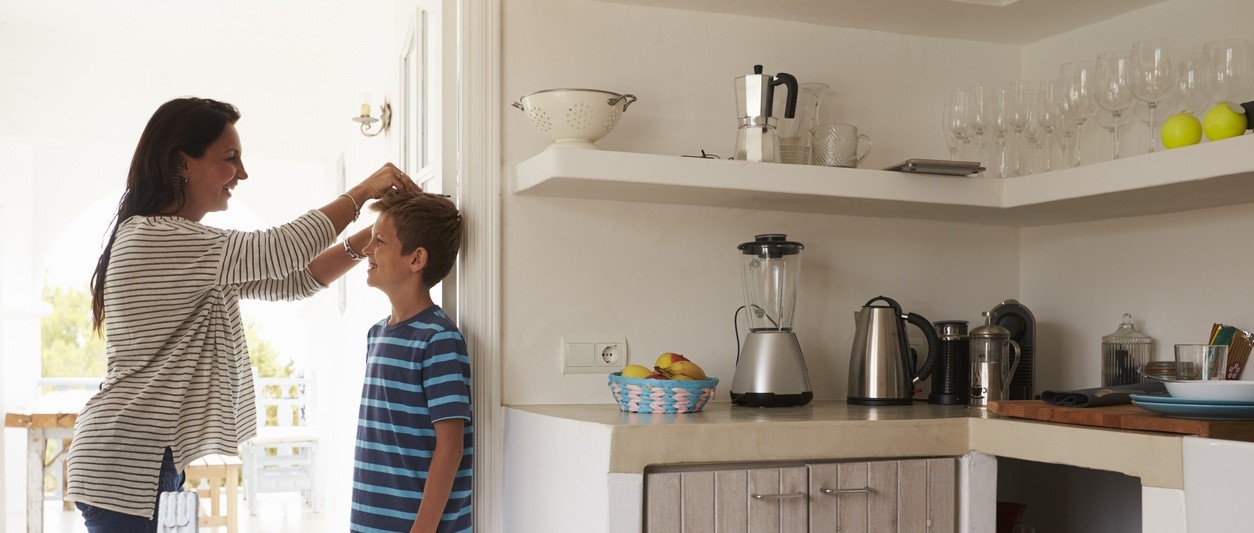
Wie Ihre Körpergröße Ihre Gesundheit beeinflusst
Fachlich geprüft von Dr Hayley Willacy, FRCGP Zuletzt aktualisiert von Dr Sarah JarvisZuletzt aktualisiert 19 Aug 2018
Erfüllt die Anforderungen des Patienten redaktionellen Richtlinien
- HerunterladenHerunterladen
- Teilen
- Language
- Diskussion
- Audio-Version
- Zu bevorzugten Quellen bei Google hinzufügen
I have an admission to make - I'm short. Not the kind of short where you can stand ramrod straight and fit in - even in heels, there are 10-year-olds I have to look up to. I've never minded that much - my mother constantly reminded me in my teens that tall women's options for boyfriends were much more limited than mine.
But a aktuelle Studie suggesting my height might be putting me at higher risk of heart disease made me stop and think. I can live with the idea that my lifestyle - diet, smoking, exercise, weight - could boost or cut my risks, but there's nothing I can do to make myself taller.
So I did a bit of digging and found the news was mixed. For some conditions, being pocket-sized is a positive advantage, but for others every couple of inches could spell disaster.
Koronare Herzkrankheit
The most recent study suggested that someone like me, who just squeezes over the 5ft mark, has a 32% higher risk of heart disease than an equivalent woman of 5ft 6in. Apparently every two and a half inches you gain, cuts your risk of coronary heart disease (CHD) by about 13%. On the plus side, I'm not overweight, I don't have Typ-2-Diabetes, Bluthochdruck oder erhöhter Cholesterinspiegel and I don't mehr rauchen, so my risks were relatively low to start with.
Some scientists have suggested that being short means your coronary arteries are narrower, and so more prone to becoming blocked by fatty plaques. But other studies on identical twins suggest that if one twin is shorter, they're more likely to have a Herzinfarkt. This raises the possibility of 'nurture not nature' - since identical twins have identical DNA, their height is affected not by the genes they inherit but by factors in their environment, such as childhood illness or diet.
Interestingly, while heart disease often runs in families, a major study in the last decade has suggested that the vast majority of the risk of having a heart attack can be explained by lifestyle factors (smoking, waistline, exercise, diet, alcohol intake, etc) rather than heredity. So while this finding is interesting, it doesn't change the advice we give to patients.
Schlaganfall
Shorter people come off worse in the stroke stakes too, with every extra inch cutting your risk of stroke by 6.5%. Once again, scientists have pointed the finger at childhood nutrition, but inherited hormone differences may play a part.
Krebs
On the plus side for those of us who are vertically challenged, most cancers connected with height seem to favour the smaller person. Taller women are at higher risk than their shorter counterparts of Darmkrebs, Eierstockkrebs, Brustkrebs, Hautkrebs und Leukämie. Men are at higher risk of Prostatakrebs if they're taller. The skin cancer/height link might be explained by taller women simply having more skin to become damaged by the sun, but bigger women don't necessarily have bigger breasts, and prostate gland size isn't linked to height.
Whatever the reasons, the best way to protect yourself against cancer is still a healthy lifestyle - the link between height and smoking-related cancers like Lungenkrebs was much weaker.
Sicher sun exposure, a diet high in fruit and veg and lower in processed food, moderate alcohol intake und regelmäßige Bewegung probably have far more influence than height.
Alzheimer-Krankheit
Alzheimer-Krankheit is another condition which seems to be more common in short than tall people. Your risk of the second most common form of Demenz, vascular dementia, is closely linked to the same risk factors as heart disease, but studies haven't shown the same benefits in Alzheimer's disease from addressing your cardiovascular risks.
However, having a family history of Alzheimer's disease does increase your chance of getting it, so this may suggest a connection between genes affecting height and Alzheimer's disease.
Inherited diseases
Some diseases are the consequence rather than the cause of height differences. For instance, having Marfan-Syndrom, a connective tissue disease, means you're likely to be very tall, as well as more likely to have an aortic aneurysm, scoliosis, a detached retina and a collapsed lung.
Menschen mit Down-Syndrom, by contrast, tend to be much shorter than average.
When I'm teaching other doctors and they're wondering what investigations to do or what advice to give, one of my most common questions to them is: "Will it change your management?" In the case of height and health, the answer is no. We can't change our stature, but we can certainly stack the odds in our favour with simple lifestyle changes. For now, that's good enough for me.
Patientenauswahl für Gesundheitswesen

Allgemeine Gesundheit und Lebensstil
Wie hilft Technologie dabei, Patienten die Kontrolle über ihre eigene Gesundheit zu geben?
Dank technologischer Fortschritte können Patienten ihre Gesundheit heute besser denn je selbst verwalten, ohne das Zuhause verlassen zu müssen. Besonders während der Pandemie war die Technologie für viele Patienten eine Rettung, um ihre Ärzte zu konsultieren und Medikamente zu bestellen. Aber wie hat die Technologie das Gesundheitswesen noch revolutioniert und Patienten befähigt, die Kontrolle über ihre Erkrankungen zu übernehmen?
von Emily Jane Bashforth
Allgemeine Gesundheit und Lebensstil
Familien werden aufgefordert, über Organspende zu sprechen, bevor ein geliebter Mensch stirbt
Thousands of transplant opportunities are being missed because families don't know if their family member would want to donate their organs after they die.
von Milly Evans
Über den AutorVollständige Biografie anzeigen

Dr. Sarah Jarvis
Klinische Beraterin
MA (Cantab), BM, BCh (Oxon), DRCOG, FRCGP, MBE
Nach ihrer medizinischen Ausbildung in Cambridge und Oxford wurde Dr. Sarah Jarvis MBE Hausärztin.
Über den RezensentenVollständige Biografie anzeigen

Dr Hayley Willacy, FRCGP
Allgemeinmediziner, Medizinischer Autor
MBChB (1992), DRCOG, DFFP, MRCOG (Part 1) MRCGP (2007), DFSRH (2013), MSc - medical education (2020)
Dr. Hayley Willacy war eine NHS-Hausärztin, die in Nordwestengland arbeitete und 2022 nach 30 Jahren aus der klinischen Praxis ausschied.
Artikelverlauf
Die Informationen auf dieser Seite werden von qualifizierten Klinikern begutachtet.
Artikel auch verfügbar in Englisch, Deutsch, Spanisch, Französisch, Italienisch, Portugiesisch, Hindi, Hebräisch, Arabisch, und Schwedisch.
19 Aug 2018 | Neueste Version

Fragen, teilen, verbinden.
Durchsuchen Sie Diskussionen, stellen Sie Fragen und teilen Sie Erfahrungen zu Hunderten von Gesundheitsthemen.

Fühlen Sie sich unwohl?
Bewerten Sie Ihre Symptome online kostenlos
Abonnieren Sie den Patienten-Newsletter
Ihre wöchentliche Dosis klarer, vertrauenswürdiger Gesundheitsberatung - geschrieben, um Ihnen zu helfen, sich informiert, selbstbewusst und in Kontrolle zu fühlen.
Durch das Abonnieren akzeptieren Sie unsere Datenschutzrichtlinie. Sie können sich jederzeit abmelden. Wir verkaufen Ihre Daten niemals.
Mehr zu allgemeiner Gesundheit und Lebensstil
- 8 häufige Gesundheitssymptome, die Sie niemals ignorieren sollten
- Fördert kaltes Wetter den Gewichtsverlust?
- Funktioniert die Selbstdiagnose und welche Gefahren gibt es?
- Familien werden aufgefordert, über Organspende zu sprechen, bevor ein geliebter Mensch stirbt
- Malaria-Tabletten von Ihrem Apotheker erhalten
- Heuschnupfen: Wie man mit einer 'Pollenbombe' umgeht'
- Gesundheitschecks, die Sie zu Hause durchführen können
- Wie man das richtige Sonnenschutzmittel auswählt
- Wie man im Winter gesundes Seelenfutter isst
- Wie man im Freien mit einer Hitzewelle zurechtkommt
- Wie man mit einer unheilbaren Krankheit an Weihnachten umgeht
- Wie man über Weihnachten und Neujahr sicher trinkt
- Wie Sie Ihren Kindern helfen, über Weihnachten gesund zu essen
- Wie Sie Ihre Fitness-Neujahrsvorsätze einhalten
- Wie Sie Ihr Sodbrennen an Weihnachten in den Griff bekommen
- Wie man trockene Augen im Winter verhindert
- Fettleibigkeit verantwortlich für weniger geeignete Organspender
- Pharmacy First - das Beste aus Ihrem Apotheker herausholen
- Was sind EDCs und warum sollten Sie sich darüber Sorgen machen?