Medicine for high blood pressure
Peer reviewed by Dr Toni Hazell, FRCGPLast updated by Dr Philippa Vincent, MRCGPLast updated 28 Jul 2023
Meets Patient’s editorial guidelines
- DownloadDownload
- Share
- Language
- Discussion
- Audio Version
- Add to preferred sources on Google
For detailed information about your own medication you should read the leaflet that comes inside the medicine packet.
At a glance
There are six main types of medicine used to lower blood pressure.
These are ACE inhibitors, ARBs, calcium-channel blockers, 'water' tablets, beta-blockers, and alpha blockers.
Your doctor will choose the best drug or combination for you based on various factors.
Common side-effects are usually mild, and listed in the medicine packet leaflet.
Most people need to take blood pressure medication for life.
Always seek medical advice if you think a problem might be due to your medication.

Unsure about mixing medicines?
Check for possible interactions between medicines, supplements and foods before taking them together.
What are the types of blood pressure medicines?
There are six main classes of medicines that are used to lower blood pressure:
Angiotensin-converting enzyme (ACE) inhibitors.
Angiotensin receptor blockers (ARBs).
Calcium-channel blockers.
'Water' tablets (thiazide diuretics).
Beta-blockers.
Alpha blockers
The following gives a brief overview of each of the classes.
Angiotensin-converting enzyme (ACE) inhibitors
ACE inhibitors work by reducing the amount of a chemical, called angiotensin II, that is made in the bloodstream. This chemical tends to narrow (constrict) blood vessels. If there is less of this chemical, the blood vessels relax and widen and so the pressure of blood within the blood vessels is reduced.
An ACE inhibitor is used first line in white or Asian people under the age of 55 but is also particularly useful for people who have heart failure, chronic kidney disease or diabetes. ACE inhibitors are not used in pregnant or breastfeeding women. Blood tests are needed before starting an ACE inhibitor to check that the kidneys are working well and then the blood test is repeated within two weeks after starting the medicine and within two weeks after any increase in dose. After that, a yearly blood test is required.
For more information see the separate leaflet called ACE Inhibitors.
Angiotensin receptor blockers (ARBs)
These medicines are sometimes called angiotensin-II receptor antagonists. There are various types and brands. The ones available in the UK are: azilsartan, candesartan, eprosartan, irbesartan, losartan, olmesartan, telmisartan and valsartan. They work by blocking the effect of angiotensin II on the blood vessel walls. They have a similar effect to ACE inhibitors (described above) and blood tests are needed at the same times as with ACE inhibitors.
Calcium-channel blockers
Calcium-channel blockers affect the way calcium is used in the blood vessels and heart muscle. This has a relaxing effect on the blood vessels. Calcium-channel blockers can also be used to treat angina. These are used first-line in patients over 55 and in patients of Afro-Caribbean origin where ACE inhibitors don't tend to be as effective.
For more information see the separate leaflet called Calcium-channel Blockers.
'Water' tablets
'Water' tablets (diuretics) work by increasing the amount of salt and fluid that is passed out in the urine. This has some effect on reducing the fluid in the circulation, which reduces blood pressure. They may also have a relaxing effect on the blood vessels, which reduces the pressure within the blood vessels.
The most commonly used diuretics to treat high blood pressure (hypertension) in the UK are thiazides or thiazide-like diuretics. Only a low dose of a diuretic is needed to treat high blood pressure. Therefore, there is not a significant diuretic effect (that is, not much extra urine is passed). Thiazides are often the preferred treatment in people who can't tolerate other types of medicine or have heart failure.
A blood test is needed before starting a diuretic to check that the kidneys are working well. A blood test within 4-6 weeks of starting treatment with a diuretic is also required , to check that the blood potassium has not been affected. After that, a yearly blood test is usual.
For more information see the separate leaflet called Thiazide Diuretics.
Beta-blockers
Beta-blockers are no longer usually used for blood pressure treatment alone. This is because they have been found to be less effective in preventing heart attacks and strokes than other medication choices. However, sometimes they may be used where there are other conditions present, such as heart failure or atrial fibrillation.
They work by slowing the heart rate, and reducing the force of the heart. These actions lower the blood pressure. Beta-blockers are also commonly used to treat angina and some other conditions. You should not normally take a beta-blocker if you have asthma, chronic obstructive pulmonary disease (COPD), or certain types of heart or blood vessel problems.
For more information see the separate leaflet called Beta-blockers.
Alpha blockers
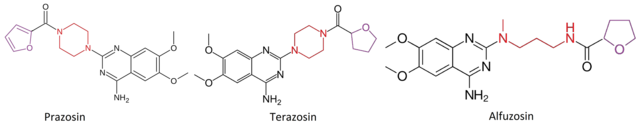
Alpha blockers are usually added in to blood pressure medication if the first and second line treatments are not working well enough. They work by allowing the blood vessels to relax and widen, therefore allowing more blood to flow through them. The alpha blockers available in the UK include doxazosin and prazosin. They can be particularly useful in men with an enlarged prostate gland.
Side-effects of blood pressure medicines
All medicines have possible side-effects, and no medicine is without risk. However, most people who take medicines to lower blood pressure do not develop any side-effects or only have mild side-effects. A full list of cautions and possible side-effects is listed on the leaflet inside the medicine packet. The most common side-effects are:
ACE inhibitors - sometimes cause an irritating cough.
ARBs - sometimes cause dizziness.
Calcium-channel blockers - sometimes cause dizziness, facial flushing, swollen ankles, and constipation.
'Water' tablets (diuretics) - can cause gout attacks in a small number of users, or can make gout worse in someone who already has gout. Erection problems (impotence) develop in some users.
Beta-blockers - can cause cool hands and feet, poor sleep, tiredness and impotence in some users.
Alpha blockers - rarely cause side effects but can cause tiredness and swollen ankles.
If a side-effect does occur, a different medicine may be better. There is a lot of choice so one can usually be found to suit. Medical advice should be sought if a problem develops which might be due to medication (a pharmacist can often advise on this).
Other medicines for high blood pressure
Apart from the five main classes of medicines listed above, sometimes other medicines are used to lower blood pressure. For example:
Spironolactone is another stronger 'water' tablet (diuretic) sometimes used as an add-on option for blood pressure which is difficult to control. Spironolactone is not usually given alongside ACE inhibitors or ARBs because the combination can cause potassium levels in the body to become dangerously high. Regular blood tests to check for this are needed.
Combinations of medicines
One medicine alone may not be enough. One medicine alone can reduce high blood pressure (hypertension) to the target level in less than half of cases. It is common to need two or more different medicines to reduce high blood pressure to a target level. In about a third of cases, three medicines or more are needed to get blood pressure to the target level.
So, for example, an ACE inhibitor plus a calcium-channel blocker (and sometimes also another medicine) might be needed to control blood pressure. This is just an example, and various combinations of medicines can be used.
Often a lower dose of two or three different types of blood pressure medication works better than a higher dose of just one.
In some cases, despite treatment, the target level is not reached. However, although to reach a target level is ideal, benefit is gained from any reduction of high blood pressure.
Which is the best medicine or combination of medicines?
The one or ones chosen may depend on factors such as:
Any other medical problems.
Ethnic origin.
Any other medication.
Possible side-effects.
Age.
For example:
Beta-blockers and calcium-channel blockers can also treat angina.
ACE inhibitors also treat heart failure.
Some medicines are not suitable in pregnancy.
Some medicines are thought to be better in people with diabetes.
Some medicines tend to work better than others in people of Afro-Caribbean origin.
If there are no other medical problems that warrant a particular medicine then current UK guidelines give the following recommendations. These recommendations are based on treatments and combinations of treatments that are likely to give the best control of the blood pressure with the least risk of side-effects or problems.
Treatment is guided by the A/C, A+C, A+C+D approach, where:
A = ACE inhibitor or ARB.
C = calcium-channel blocker.
D = diuretic.
The suggested stepwise approach is as follows:
In someone less than 55 years old and not of black African or Caribbean origin then treatment usually begins with an 'A' (an ACE inhibitor or an ARB if an ACE inhibitor causes problems or side-effects).
In someone who is 55 years or older, or is of black African or Caribbean origin then treatment usually begins with a 'C' (a calcium-channel blocker).
Then, if the blood pressure has not reached the target, the next stage would be to combine 'A' with 'C' (an ACE inhibitor or an ARB plus a calcium-channel blocker). The National Institute for Health and Care Excellence (NICE) recommend that ARBs may work better than ACE inhibitors in people of black African or Caribbean origin.
If the target blood pressure is still not reached, the third stage would be to combine 'A' with 'C' and 'D' (that is, adding a diuretic).
Many people of black African or Caribbean origin are diagnosed with high blood pressure, and most need two or more medicines to control their blood pressure. One study found that a combination of amlodipine (a 'C'' drug) with perindopril (an 'A' drug) or hydrochlorothiazide (a 'D' drug) was more effective at controlling blood pressure than the A drug combined with the D drug.
If a fourth medicine is needed to achieve the target blood pressure, one of the following is usually used:
A beta-blocker.
Another diuretic.
An alpha-blocker.
However, individuals can vary as to which combination best controls their blood pressure. Sometimes, if one medicine does not work so well or causes side-effects, a switch to a different class of medicine may work well.
How long does blood pressure medicine take to work?
In most cases, medication is needed for life. However, in some people whose blood pressure has been well controlled for three years or more, medication may be able to be stopped. In particular, this may be possible for people who have made significant changes to lifestyle (such as having lost a lot of weight, or stopped heavy drinking, etc). ,
People who stop medication should continue to have regular blood pressure checks. In some cases the blood pressure remains normal. However, in others it starts to rise again. If this happens, medication can then be started again.
As people age, blood pressure tends to increase. However, in the very elderly, it is common for blood pressure to start to decrease. Medical advice should be sought for any dizziness or falls in the elderly as it is important to check the blood pressure reading and see whether the doses of any blood pressure medication should be reduced.
Patient picks for Heart and blood medicines

Treatment and medication
Peripheral vasodilators
Peripheral vasodilators are medicines that are used to treat conditions that affect blood vessels in outer (peripheral) parts of the body such as the arms and legs. For example, they are used to treat peripheral arterial disease and Raynaud's phenomenon. They ease the symptoms of these conditions by dilating the blood vessels, preventing them from becoming narrower (constricting). These medicines are usually only prescribed after self-help measures have been tried and symptoms do not improve.
by Dr Surangi Mendis, MRCGP
Treatment and medication
Alpha-blockers
Alpha-blockers are medicines that are mainly used to treat high blood pressure (hypertension) and problems with passing urine in men who have enlargement of the prostate gland. Prostate gland enlargement is also called benign prostatic hyperplasia (BPH).
by Dr Doug McKechnie, MRCGP
Frequently asked questions
What is angiotensin II, and why is it important in blood pressure regulation?
Angiotensin II is a chemical that naturally occurs in the bloodstream. Its primary function related to blood pressure is to narrow (constrict) blood vessels. By reducing the amount of this chemical, ACE inhibitors allow blood vessels to relax and widen, which in turn lowers blood pressure.
Are there any specific lifestyle changes that can help reduce the need for blood pressure medication?
Yes, in some cases, significant lifestyle changes can potentially reduce or even eliminate the need for blood pressure medication. For example, losing a significant amount of weight or stopping heavy drinking are mentioned as changes that might allow medication to be stopped if blood pressure has been well controlled for several years.
Why are beta-blockers not typically used as a first-line treatment for high blood pressure anymore?
Beta-blockers are generally not used for blood pressure treatment alone as they have been found to be less effective than other medications in preventing serious complications like heart attacks and strokes. However, they may still be used if other conditions such as heart failure or atrial fibrillation are present.
Can I stop taking my blood pressure medicine if my readings have been normal for a while?
While medication is generally needed for life, in some cases where blood pressure has been well controlled for three or more years, and particularly if significant lifestyle changes have been made (like weight loss or reduced alcohol intake), it might be possible to stop. However, regular blood pressure checks are essential, as it can start to rise again, requiring medication to be restarted.
What does the A/C, A+C, A+C+D approach mean in terms of blood pressure treatment?
This approach is a guideline for selecting and combining blood pressure medications. 'A' represents an ACE inhibitor or ARB, 'C' stands for a calcium-channel blocker, and 'D' refers to a diuretic. It outlines a stepwise treatment plan, often starting with one type and adding others if the target blood pressure isn't achieved.
Further reading and references
- Description of the DASH (Dietary Approaches to Stop Hypertension) Eating Plan; National Institutes of Health
- Ettehad D, Emdin CA, Kiran A, et al; Blood pressure lowering for prevention of cardiovascular disease and death: a systematic review and meta-analysis. Lancet. 2016 Mar 5;387(10022):957-67. doi: 10.1016/S0140-6736(15)01225-8. Epub 2015 Dec 24.
- Comparison of combinations of blood pressure-lowering drugs in black African patients with hypertension; New England Journal of Medicine (NEJM)
- Hypertension in adults: diagnosis and management; NICE (August 2019 - last updated February 2026)
- Cardiovascular disease: risk assessment and reduction, including lipid modification; NICE Clinical Guideline (July 2014 -last updated May 2023) Replaced by NG238
- Definition of Hypertension and Pressure Goals during Treatment; European Society of Cardiology
About the authorView full bio

Dr Philippa Vincent, MRCGP
General Practitioner, Medical Author
MB BS, Bsc, MRCGP (2000), DCH, DFSRH, DRCOG
Dr Philippa Vincent is an NHS GP working in North London.
About the reviewerView full bio

Dr Toni Hazell, FRCGP
MBBS, BSc, FRCGP, DFSRH, Dip GU med, DRCOG, DCH (London, UK, 2000)
Dr. Toni Hazell qualified from St. Mary’s Hospital Medical School and did her VTS at Northwick Park Hospital.
Article history
The information on this page is written and peer reviewed by qualified clinicians.
Article also available in English, German, Spanish, French, Italian, Portuguese, Hindi, Hebrew, Arabic, and Swedish.
Next review due: 26 Jul 2028
28 Jul 2023 | Latest version
Join the conversation
Share your thoughts or experiences with others in our patient communities.

Ask, share, connect.
Browse discussions, ask questions, and share experiences across hundreds of health topics.

Feeling unwell?
Assess your symptoms online for free
Sign up to the Patient newsletter
Your weekly dose of clear, trustworthy health advice - written to help you feel informed, confident and in control.
By subscribing you accept our Privacy Policy. You can unsubscribe at any time. We never sell your data.
More in treatment and medication
- Biological medicines for rheumatoid arthritis
- Chemotherapy
- Controlled breathing
- Coronary angioplasty
- Cough medicines
- Dealing with a child who is unresponsive
- Haemodialysis
- HPV vaccine
- Immunisation for flu
- Japanese encephalitis vaccine
- Medication-overuse headache
- Migraine treatment
- MMR vaccination
- Refer yourself to NHS drug and alcohol support services
- Refer yourself to NHS sexual health services
- Shockwave therapy
- Tetanus and the tetanus vaccine
- Tick-borne encephalitis vaccine
- Typhoid vaccine
- Yellow fever vaccine