Blasenpemphigoid
Begutachtet von Dr Rosalyn Adleman, MRCGPZuletzt aktualisiert von Dr Caroline Wiggins, MRCGP Zuletzt aktualisiert 25 May 2023
Erfüllt die Anforderungen des Patienten Richtlinien des Patienten
- HerunterladenHerunterladen
- Teilen
- Language
- Diskussion
- Audio-Version
- Zu bevorzugten Quellen bei Google hinzufügen
In dieser Serie:Pemphigus vulgaris
Die bullöse Pemphigoid ist eine Hautkrankheit, die einen Ausschlag, Juckreiz und Blasen verursachen kann. Sie betrifft hauptsächlich Menschen über 70 Jahre. Die Behandlung wirkt in der Regel gut, um die Symptome zu kontrollieren. Die Behandlung erfolgt normalerweise mit Steroidcremes oder Medikamenten, aber manchmal können auch andere Medikamente verwendet werden. Die Krankheit neigt dazu, nach 3-6 Jahren zu verschwinden, und dann kann die Behandlung gestoppt werden. Manchmal bleibt die Krankheit bestehen.
Auf einen Blick
Bullous pemphigoid is a rare skin condition causing a rash, itching, and blisters.
It is an autoimmune disease where the immune system attacks the skin.
Symptoms include itchy skin, a pink rash, and firm, fluid-filled blisters.
Blisters mostly appear on the arms, legs, armpits, and groin.
Diagnosis involves a skin biopsy and a blood test.
Steroids, as creams or tablets, are the main treatment.
The condition usually clears up after 3-6 years, but can be serious in widespread cases.
What is bullous pemphigoid?
Bullous pemphigoid is a skin condition that can cause a rash, itching and blisters.
There are several skin conditions which cause blisters. It is important to know exactly which disease you have as they have similar sounding names but vary greatly in their seriousness, outlook (prognosis) and treatment. For example, see the separate leaflet called Pemphigus Vulgaris (which is generally more serious than bullous pemphigoid).
Symptoms of bullous pemphigoid
Symptoms of bullous pemphigoid include:
Areas of itchy skin.
Pink rash which can look like eczema or Urtikaria.
Firm and dome-shaped fluid-filled blisters.
Small blisters inside the mouth or on the lips.
The itch or rash can develop weeks or months before the blisters appear.
Any area of skin can be affected, but blisters mostly occur on the arms, legs, armpits and groin. The amount of blistering can vary: sometimes it is just one area, such as the lower leg. In severe cases, the whole body may be affected.
This photo shows the typical blisters:
Bullous pemphigoid leg blisters
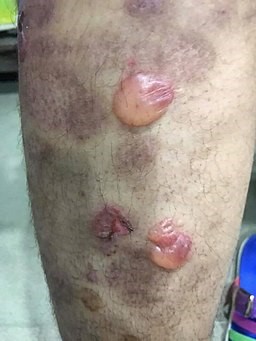
© Mohammad2018, CC BY-SA 4.0, über Wikimedia Commons
How common is bullous pemphigoid?
Bullous pemphigoid is rare. In the UK it is estimated that between 4-5 people in 100,000 develop it each year. Most people with bullous pemphigoid are aged over 70. It is very rare in children. It is not contagious so you cannot catch it from an affected person.
It can come on in pregnancy, when it is called gestational pemphigoid and requires careful management by a dermatologist and an obstetrician together.
What causes bullous pemphigoid?
Bullous pemphigoid is an autoimmune disease. Das Immunsystem normally makes antibodies to attack bacteria, viruses, and other germs. In people with bullous pemphigoid, the immune system makes antibodies against the basement membrane between the top layer of skin (the epidermis) and the next layer (the dermis). This causes fluid to build up as blisters between these two layers of skin.
It is not known what causes bullous pemphigoid. but certain conditions and medications may trigger it. They include:
Diseases which involve the nervous system such as dementia and multiple sclerosis.
Medications such as furosemide, Nichtsteroidale entzündungshemmende Medikamente (NSAIDs), captopril, some diabetes medicines and some antibiotic medicines.
Can stress cause bullous pemphigoid?
There is no evidence that stress causes or triggers this condition.
How is bullous pemphigoid diagnosed?
The diagnosis may take a while as it may look like eczema or an allergy at first. There are also several conditions which can cause blisters. If your doctor suspects that you have bullous pemphigoid, they will refer you to a skin specialist. Tests are usually done to confirm the diagnosis. These are:
Eine kleine Probe (Biopsie) of skin may be taken. This is looked at under the microscope and tested to confirm that the blisters are due to bullous pemphigoid.
Bluttest can detect the antibody that causes bullous pemphigoid (the bullous pemphigoid auto-antibody).
Bullous pemphigoid treatment
Treatment aims to improve your symptoms and avoid side effects.
Treatments used for bullous pemphigoid are:
Steroide
Steroids are the main treatment for bullous pemphigoid.
High-strength steroid creams, also called topical steroids (zum Beispiel, Clobetasol) will normally be needed.
Steroid tablets such as Prednisolon are commonly used with or without steroid creams, especially if the rash is on more than one body area, or there are practical problems applying the cream. Steroids reduce inflammation and suppress the immune system.
Nebenwirkungen
All steroids can have side-effects. Side-effects from steroids can be serious, especially if you take high doses for a long time.
If you take steroid treatment for more than a month, you will usually be advised to take additional medications to reduce the risk of serious side effects. It is important not to stop steroids without discussing it with your doctor first. For more information see the separate leaflet called Oral Steroids.
Other drugs to calm the immune system may be used if you cannot use steroids or they are not working to control your condition.
Looking after your skin is important with this condition, and you may be advised to use certain creams or moisturisers to wash with, or apply to your skin to keep it in the best condition possible.
What is the outlook for bullous pemphigoid?
Bullous pemphigoid usually goes away after 3-6 years. Treatment can then be stopped. In some people the condition unfortunately persists.
Widespread or severe bullous pemphigoid is a serious condition. In addition to the side effects caused by the treatments, it can be fatal due to the risk of broken areas of skin developing a bacterial infection.
Patientenauswahl für Hautausschläge

Haut-, Nagel- und Haargesundheit
Pemphigus vulgaris
Pemphigus vulgaris ist eine sehr ernste Hautkrankheit, die Blasen verursacht. Sie ist selten. Pemphigus vulgaris ist ernster als die meisten anderen blasenbildenden Hauterkrankungen. Bevor eine Behandlung verfügbar war, starben die meisten Menschen mit dieser Erkrankung kurz nach Beginn der Krankheit. Heutzutage können die meisten Fälle mit einer Behandlung kontrolliert werden. Die Behandlung erfolgt in der Regel mit Steroidmedikamenten und anderen Medikamenten zur Unterdrückung des Immunsystems. Ein Hautspezialist sollte die Behandlung überwachen.
von Dr. Oliver Starr, MRCGP

Haut-, Nagel- und Haargesundheit
Lichen planus
Lichen planus verursacht hauptsächlich einen juckenden Hautausschlag. Bei einigen Menschen betrifft es auch andere Körperteile wie den Mund, die Genitalien, Nägel und Haare. Die meisten Menschen erholen sich innerhalb von 6-12 Monaten. Die Behandlung, meist mit einer Steroidcreme oder -salbe, lindert oft den Juckreiz und kann den Ausschlag reduzieren, bis die Erkrankung abklingt.
von Dr. Hayley Willacy, FRCGP
Häufig gestellte Fragen
Can bullous pemphigoid affect internal organs or spread throughout the body?
Bullous pemphigoid primarily affects the skin, causing blisters. Blisters can also occur inside the mouth or on the lips. While the condition can be widespread on the skin, there is no information to suggest it affects internal organs.
Are there any specific lifestyle changes or dietary recommendations that can help manage bullous pemphigoid?
The article does not specify any particular lifestyle changes or dietary recommendations for managing bullous pemphigoid. Treatment mainly focuses on using steroids and other medications to calm the immune system, and skin care with creams or moisturisers.
What should I do if I suspect a blister has become infected?
The article mentions that widespread or severe bullous pemphigoid can be serious due to the risk of broken areas of skin developing a bacterial infection. While it doesn't give specific advice on what to do if you suspect an infection, it highlights this as a potential serious complication.
Is bullous pemphigoid hereditary or does it run in families?
The article does not state that bullous pemphigoid is hereditary or that it runs in families. It is described as an autoimmune disease where the immune system mistakenly attacks healthy skin cells.
How often will I need to see a doctor once I've been diagnosed with bullous pemphigoid?
The article does not specify how frequently follow-up appointments are needed after a diagnosis of bullous pemphigoid. It mentions that if pregnant, careful management by a dermatologist and obstetrician together is required, and that treatment usually lasts 3-6 years.
Weiterführende Literatur und Referenzen
- Guidelines for the management of bullous pemphigoid; British Association of Dermatologists (2012)
- Di Lernia V, Casanova DM, Goldust M, et al; Pemphigus vulgaris und bullöses Pemphigoid: Aktualisierung der Diagnose und Behandlung. Dermatol Pract Concept. 2020 Jun 29;10(3):e2020050. doi: 10.5826/dpc.1003a50. eCollection 2020 Jul.
- DermnetNZ Bullous Pemphigoid
Über den AutorVollständige Biografie anzeigen

Dr Caroline Wiggins, MRCGP
Allgemeinmediziner, Medizinischer Autor
MBBS Auszeichnung (mit Auszeichnung), MRCGP (2016), MSc.SEM (mit Auszeichnung), BSc (Hons)
Dr. Caroline Wiggins ist derzeit als Vertretungsärztin im Südwesten Englands tätig.
Über den RezensentenVollständige Biografie anzeigen

Dr Rosalyn Adleman, MRCGP
MRCGP
Dr. Rosalyn Adleman ist eine NHS-Ärztin, die in Nordlondon arbeitet.
Artikelverlauf
Die Informationen auf dieser Seite wurden von qualifizierten Klinikern verfasst und begutachtet.
Artikel auch verfügbar in Englisch, Deutsch, Spanisch, Französisch, Italienisch, Portugiesisch, Hindi, Hebräisch, Arabisch, und Schwedisch.
Next review due: 23 May 2028
25 May 2023 | Neueste Version

Fragen, teilen, verbinden.
Durchsuchen Sie Diskussionen, stellen Sie Fragen und teilen Sie Erfahrungen zu Hunderten von Gesundheitsthemen.

Fühlen Sie sich unwohl?
Bewerten Sie Ihre Symptome online kostenlos
Abonnieren Sie den Patienten-Newsletter
Ihre wöchentliche Dosis klarer, vertrauenswürdiger Gesundheitsberatung - geschrieben, um Ihnen zu helfen, sich informiert, selbstbewusst und in Kontrolle zu fühlen.
Durch das Abonnieren akzeptieren Sie unsere Datenschutzrichtlinie. Sie können sich jederzeit abmelden. Wir verkaufen Ihre Daten niemals.
Mehr über Haut-, Nagel- und Haargesundheit
- Fußpilz
- Atopisches Ekzem
- Morbus Bowen
- Katzenkratzkrankheit
- Ekzem bei Kindern
- Emollientien und Ekzemcremes
- Erythema nodosum
- Pilzinfektion in der Leistengegend
- Pilzinfektion der Nägel
- Hitzepickel und Hitzefriesel
- Insektenstiche und -bisse
- Lipom
- Mpox-Virus
- Nagelpsoriasis
- Krätze
- Seborrhoische Warzen
- Gürtelrose
- Venöse Beingeschwüre
- Warzen und Verrucas