Hysteroskopie
Begutachtet von Dr Colin Tidy, MRCGPZuletzt aktualisiert von Dr Philippa Vincent, MRCGPZuletzt aktualisiert 3. Aug 2023
Erfüllt die Anforderungen des Patienten Richtlinien des Patienten
- HerunterladenHerunterladen
- Teilen
- Language
- Diskussion
- Audio-Version
- Zu bevorzugten Quellen bei Google hinzufügen
Hysteroskopie ist ein Verfahren, bei dem ein dünnes, röhrenförmiges Endoskop verwendet wird, um das Innere der Gebärmutter zu betrachten. Es ermöglicht Ärzten auch, kleinere Eingriffe an der Gebärmutter durchzuführen.
Auf einen Blick
A hysteroscopy is a procedure to look inside the womb (uterus) using a slim instrument called a hysteroscope.
Es kann helfen, Probleme wie starke Blutungen, Blutungen nach den Wechseljahren, Unfruchtbarkeit und wiederkehrende Fehlgeburten zu diagnostizieren.
It can also be used to remove polyps, scar tissue, or lost contraceptive devices.
Eine Hysteroskopie kann mit oder ohne Anästhesie durchgeführt werden und dauert normalerweise 5 bis 30 Minuten.
Nach dem Eingriff sind krampfartige Schmerzen wie bei der Periode und leichte Blutungen bis zu sieben Tage lang üblich.
Suchen Sie ärztlichen Rat, wenn Sie Fieber, zunehmende Schmerzen, übelriechenden Ausfluss oder starke Blutungen entwickeln.
What is a hysteroscopy?
Hysteroscopy allows a doctor to look inside the womb (uterus). This is done using an instrument called a hysteroscope. The hysteroscope is very slim (about 3 to 5 millimetres in diameter). It's carefully passed through the vagina and neck of the womb (cervix) and into the uterus.
What happens during a hysteroscopy?
The hysteroscope is connected to a camera and a TV monitor which show the inside of the uterus. Some gas or fluid may be pumped into the uterus to make it swell a little. This makes it easier to see the lining of the uterus.
After this, the doctor may take a tiny piece of tissue (biopsy) from the uterus. This will be sent to the laboratory for examination under the microscope. Sometimes small fleshy lumps (polyps) are found. It may be possible to remove these during the test. After the procedure is completed the hysteroscope is gently removed.
A hysteroscopy takes between 5 and 30 minutes.
In some hospitals an ultrasound scan may be arranged before a hysteroscopy. See the separate leaflet called Ultrasound Scan for more details.
What anaesthesia is used for hysteroscopy?
A hysteroscopy can be done under general or with local anaesthetic. A general anaesthetic means being put to sleep. Some women will not have either a general or a local anaesthetic. Occasionally, a sedative may be used, which won't cause sleep but may help to feel more relaxed.
A non-steroidal anti-inflammatory painkiller (zum Beispiel, Ibuprofen) might be advised around one hour before the appointment to help reduce pain immediately after the procedure. If no general anaesthetic is used, women may be asked if they wish to see the pictures coming from the hysteroscope. Some people do not wish to do this but others find it helpful.
The doctor may use a speculum (the same instrument used in a cervical screening test) so that they can see the neck of the womb. They then pass the hysteroscope through the cervix into the uterus. Sometimes the hysteroscope will be passed into the vagina without having to use a speculum.
Are there any preparations I should consider?
Local hospitals will give guidance on what to do before a hysteroscopy. If having a hysteroscopy with local anaesthetic, there will not usually be a need for any special preparation.
If having a general anaesthetic, it will be a requirement not to eat or drink for a number of hours before the procedure.
Hysteroskopie
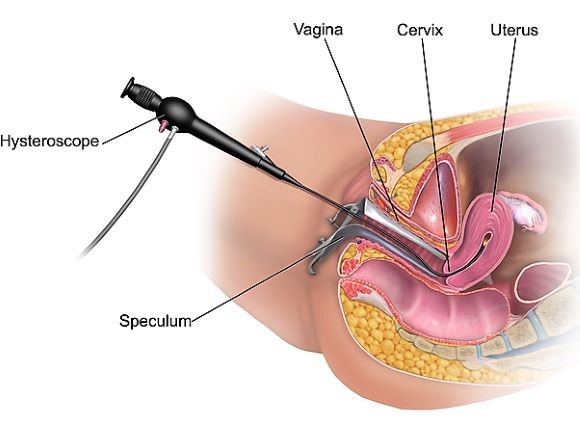
© By BruceBlaus (Own work) via Wikimedia Commons
What can be found during a hysteroscopy?
A hysteroscopy may be used to find the cause of various problems such as:
Heavy or irregular bleeding that has not improved with medication.
Bleeding in between periods.
Bleeding after the Wechseljahre.
Irregular bleeding whilst taking hormone replacement therapy (HRT).
These are called diagnostic hysteroscopies.
As well as being used to investigate the cause of various problems, a hysteroscopy can also be used to:
Remove polyps - small lumps of tissue growing on the lining of the womb (uterus).
Remove scar tissue in the uterus.
Perform endometrial ablation - a procedure where the lining of the womb is made thinner in order to prevent heavy periods.
Remove adhesions (areas where the walls of the uterus are sticking together).
Locate a 'lost' or stuck contraceptive device, such as an intrauterine contraceptive device (IUCD) - also known as a 'coil'.
Perform certain types of sterilisation procedures.
Before having the procedure the gynaecologist will discuss the test. A number of different treatment options might be discussed. This is because it may be possible to treat the cause of symptoms immediately, using the hysteroscope. In order for this, agreement (consent) to the treatment will be needed in advance.
Is a hysteroscopy painful?
If awake, there may be a feeling like period cramps at some stages. A lot of women feel no discomfort or only minimal discomfort. For other women it is very painful and the procedure has to be stopped. In this case a hysteroscopy under general anaesthetic will be likely to be offered on another day. Many different things may influence how painful the procedure is. This includes:
Whether an anaesthetic is used.
Whether local or general anaesthetic is used and, if local, which type of local anaesthetic. (There are a number of options.)
Whether pain relief is used.
The size of hysteroscope used (the thinner ones tend to be less painful).
The type of hysteroscope used (flexible or rigid).
Whether a speculum is used.
The reason for having the test.
Whether babies have been delivered vaginally (vaginal delivery) in the past.
Whether the menopause has been reached/passed.
When asked to give consent to the procedure, these sorts of issues should be discussed. It is not possible to safely have a hysteroscopy whilst you are pregnant.
What can I expect after a hysteroscopy?
After a general anaesthetic or sedation, it is necessary to rest until the effects of these have passed. Driving is not permitted for the first 24 hours and it is usual to advise that a friend or relative should stay with the person for the first 24 hours.
After a local anaesthetic, it is usual to be able to go home as normal (walking, driving or travelling by public transport) after a short rest.
Period-like cramps and mild bleeding afterwards is common. The bleeding is usually mild and should settle within seven days. To reduce the risk of infection whilst bleeding it is best to:
Use sanitary towels rather than tampons.
Avoid vaginal sex for one week after the hysteroscopy and until the bleeding has stopped.
Take it easy for the first one or two days and take painkillers as needed.
Hysteroscopy side-effects
The most common side-effects after the procedure are bleeding and pain. Very rarely it is possible that a small hole may be made in the womb (uterus) by the hysteroscope. It is also possible, although not common, to develop an infection of the uterus as a result of hysteroscopy. Some women feel faint during the procedure, when the hysteroscope is passed through the cervix, but this is usually short-lived.
Medical advice should be sought if any problems develop, such as:
A temperature.
Increased unexplained pain not relieved with painkillers.
Increased Ausfluss, which is smelly and unpleasant.
Heavy bleeding.
Patientenauswahl für Endoskopie

Chirurgie und Verfahren
Nasoendoskopie
Eine Nasoskopie ist ein Test, um das Innere der Nase (Nasengang), den hinteren Teil des Rachens (Pharynx) und den Kehlkopf (Larynx) zu untersuchen. Manchmal wird sie auch als flexible Nasenendoskopie oder FNE bezeichnet. Hinweis: Die nachstehenden Informationen sind nur eine allgemeine Orientierung. Die Abläufe und die Durchführung der Tests können in verschiedenen Krankenhäusern variieren. Befolgen Sie stets die Anweisungen Ihres Arztes oder des örtlichen Krankenhauses.
von Dr. Doug McKechnie, MRCGP

Chirurgie und Verfahren
Koloskopie
A colonoscopy is a test to assess your colon (large intestine). Note: the information below is a general guide only. The arrangements, and the way tests are performed, may vary between different hospitals. Always follow the instructions given by your doctor or local hospital.
von Dr. Claudia Berty, MRCGP
Häufig gestellte Fragen
Kann ich eine Hysteroskopie durchführen lassen, wenn ich gerade meine Periode habe?
Der Artikel gibt nicht ausdrücklich an, ob eine Hysteroskopie während der Periode durchgeführt werden kann oder nicht. Er konzentriert sich auf das Verfahren selbst, die Anästhesie und mögliche Befunde. Es ist am besten, dies mit Ihrem Gynäkologen zu besprechen, da er Ihnen basierend auf Ihren individuellen Umständen Ratschläge geben kann.
Kann ich vor einer Hysteroskopie Geschlechtsverkehr haben?
Der Artikel gibt keine spezifischen Anweisungen bezüglich sexueller Aktivitäten vor einer Hysteroskopie. Es wird jedoch empfohlen, eine Woche nach der Hysteroskopie und bis zum Abklingen der Blutung auf vaginalen Geschlechtsverkehr zu verzichten, um das Infektionsrisiko zu verringern. Für Richtlinien vor dem Eingriff geben lokale Krankenhäuser in der Regel spezifische Anweisungen.
Gibt es Gründe, warum ich möglicherweise keine Hysteroskopie durchführen lassen kann?
Die Hauptkontraindikation, die im Artikel erwähnt wird, ist die Schwangerschaft. Es heißt: "Es ist nicht möglich, während der Schwangerschaft sicher eine Hysteroskopie durchzuführen." Andere potenzielle Faktoren werden nicht diskutiert, aber Ihr Gynäkologe wird Ihre Krankengeschichte überprüfen und die Eignung des Verfahrens mit Ihnen besprechen.
Kann ich eine Hysteroskopie ablehnen?
Der Artikel deutet auf die Wahlmöglichkeit der Patienten bei medizinischen Verfahren hin, indem er erwähnt, dass eine Einwilligung erforderlich ist und alternative Behandlungsoptionen besprochen werden könnten. Auch wenn es nicht ausdrücklich gesagt wird, haben Patienten im Allgemeinen das Recht, ein medizinisches Verfahren abzulehnen, nachdem sie die Risiken und Vorteile verstanden haben. Wenn Sie Bedenken haben, sollten Sie diese mit Ihrem Gesundheitsdienstleister besprechen.
Erhalte ich meine Ergebnisse sofort nach einer Hysteroskopie?
Der Artikel erwähnt, dass wenn ein kleines Stück Gewebe (Biopsie) entnommen wird, es zur Untersuchung ins Labor geschickt wird. Dies deutet darauf hin, dass die Ergebnisse einer Biopsie nicht sofort vorliegen würden. Bei anderen Befunden, wie zum Beispiel entfernten Polypen, könnte der Gynäkologe diese während oder kurz nach dem Eingriff mit Ihnen besprechen.
Weiterführende Literatur und Referenzen
- Tangsiriwatthana T, Sangkomkamhang US, Lumbiganon P, et al; Paracervical local anaesthesia for cervical dilatation and uterine intervention. Cochrane Database Syst Rev. 2013 Sep 30;9:CD005056. doi: 10.1002/14651858.CD005056.pub3.
- Ahmad G, Attarbashi S, O'Flynn H, et al; Pain relief in office gynaecology: a systematic review and meta-analysis. Eur J Obstet Gynecol Reprod Biol. 2011 Mar;155(1):3-13. doi: 10.1016/j.ejogrb.2010.11.018. Epub 2011 Jan 20.
- Centini G, Troia L, Lazzeri L, et al; Moderne operative Hysteroskopie. Minerva Ginecol. 2016 Apr;68(2):126-32. Epub 2016 Mar 1.
- Ahmad G, Saluja S, O'Flynn H, et al; Pain relief for outpatient hysteroscopy. Cochrane Database Syst Rev. 2017 Oct 5;(10)(10):CD007710. doi: 10.1002/14651858.CD007710.pub3.
Über den AutorVollständige Biografie anzeigen

Dr Philippa Vincent, MRCGP
Allgemeinmediziner, Medizinischer Autor
MB BS, Bsc, MRCGP (2000), DCH, DFSRH, DRCOG
Dr Philippa Vincent ist ein NHS-Arzt, der in Nordlondon arbeitet.
Über den RezensentenVollständige Biografie anzeigen

Dr Colin Tidy, MRCGP
Allgemeinmediziner, Medizinischer Autor
MBBS, MRCGP, MRCP (Paediatrics), DCH
Dr. Colin Tidy ist ein NHS-Arzt mit Sitz in Oxfordshire.
Artikelverlauf
Die Informationen auf dieser Seite wurden von qualifizierten Klinikern verfasst und begutachtet.
Artikel auch verfügbar in Englisch, Deutsch, Spanisch, Französisch, Italienisch, Portugiesisch, Hindi, Hebräisch, Arabisch, und Schwedisch.
Nächste Überprüfung fällig: 1. Aug. 2028
3. Aug 2023 | Neueste Version

Fragen, teilen, verbinden.
Durchsuchen Sie Diskussionen, stellen Sie Fragen und teilen Sie Erfahrungen zu Hunderten von Gesundheitsthemen.

Fühlen Sie sich unwohl?
Bewerten Sie Ihre Symptome online kostenlos
Abonnieren Sie den Patienten-Newsletter
Ihre wöchentliche Dosis klarer, vertrauenswürdiger Gesundheitsberatung - geschrieben, um Ihnen zu helfen, sich informiert, selbstbewusst und in Kontrolle zu fühlen.
Durch das Abonnieren akzeptieren Sie unsere Datenschutzrichtlinie. Sie können sich jederzeit abmelden. Wir verkaufen Ihre Daten niemals.
Mehr zu Chirurgie und Verfahren
- Anästhesie
- Anästhesie für Hüft- oder Kniegelenkersatz
- Arthroskopie und arthroskopische Chirurgie
- Brustvergrößerung
- Koloskopie
- Häufige postoperative Komplikationen
- Koronarangioplastie
- Tod oder Hirnschäden durch Anästhesie
- Endobronchialer ultraschallgesteuerter transbronchialer Nadelaspiration
- Epidurale Schmerzbehandlung nach der Operation
- ERCP
- Fieber
- Hysterektomie
- Lippenvergrößerung
- Lokalanästhesie für Ihre Augenoperation
- Nervenschäden nach Epiduralinjektion
- Infektionen nach Splenektomie verhindern
- Übelkeit nach der Anästhesie
- Sterilisation
- Vasektomie