Geschwollene Beine
Fachlich geprüft von Dr Philippa Vincent, MRCGPZuletzt aktualisiert von Dr Doug McKechnie, MRCGPZuletzt aktualisiert 29 May 2024
Erfüllt die Anforderungen des Patienten redaktionellen Richtlinien
- HerunterladenHerunterladen
- Teilen
- Language
- Diskussion
- Audio-Version
- Zu bevorzugten Quellen bei Google hinzufügen
In dieser Serie:ÖdemIdiopathisches ÖdemLymphödem und Lipödem
Beine können aus verschiedenen Gründen anschwellen. Einige der möglichen Diagnosen sind in diesem Merkblatt aufgeführt.
Auf einen Blick
Geschwollene Beine können durch verschiedene Faktoren verursacht werden, einschließlich einer übermäßigen Flüssigkeitsansammlung (Ödem).
Ödeme können ein oder beide Beine betreffen und können eindrückbar sein, was bedeutet, dass nach dem Drücken der Haut eine Delle zurückbleibt.
Schwellungen können schmerzhaft oder schmerzlos sein, und die Hautfarbe kann rot oder normal sein.
Grübchenödeme sind häufig und können durch Hitze, lange Reisen oder Schwangerschaft verursacht werden.
Einseitige Schwellung kann durch Verletzung, Infektion, Arthritis oder eine tiefe Venenthrombose (DVT) verursacht werden.
Suchen Sie dringend einen Arzt auf, wenn Sie eine tiefe Venenthrombose (TVT) vermuten, Atemnot haben, Fieber oder starke Schmerzen verspüren.
Die Behandlung von geschwollenen Beinen hängt von der Ursache ab und kann Medikamente oder Kompressionsstrümpfe umfassen.
Types of swollen legs
There are many different kinds of swelling of the legs. One leg or both legs could be swollen. If both legs, it could be symmetrical or worse on one side. A specific part of the leg(s) could be swollen, or the entire leg(s).
It could have come on suddenly or gradually. It could be there all the time, or it could come and go. It could be painful nor not. Taking into account all these things will help narrow down the likely cause.
What causes swollen legs?
Ödem
The most common cause of swollen legs is oedema. This is a collection of excess fluid in between the cells, which are the building blocks of the tissues of our body.
Oedema can occur in one particular part of the body, or it can be generalised. If generalised, gravity takes the fluid to the part of you which is hanging down, or 'dependent'. This type may be called 'dependent oedema' by a healthcare professional.
For most people, this oedema affects their legs and tends to improve overnight after you have had your legs up. See the separate leaflet called Oedema (Swelling).
If both legs are swollen to the same level, this is likely to be oedema. It is called pitting oedema if a dent made when you press with your fingertip stays in the skin after you have taken the fingertip away.
Causes of oedema
Causes of oedema affecting both legs symmetrically include:
Heat. Some people will find their legs swell up a little in hot weather. Usually this is nothing to worry about and does not need treatment.
Long journeys or being immobile for other reasons. If your legs are hanging down and not moving for long periods of time, you can develop swollen legs. This improves once you are walking about again, or once you lie down at night.
Schwangerschaft. Pregnant women may have swollen legs in late pregnancy. Usually this is nothing to worry about, but if you are pregnant, your midwife will be doing regular checks to be sure you don't have a blood pressure problem (Präeklampsie) causing it.
Herzinsuffizienz. If you have this condition, your heart is not working as effectively to push the blood around your circulation. You may also feel out of breath, and this can be worse when lying down flat at night or on walking.
Anämie. This is a problem with the red blood cells of your body.
Venous insufficiency (which also causes varicose veins).
Kidney diseases such as nephrotisches Syndrom, akutes Nierenversagen und chronische Nierenerkrankung.
Conditions where there are low levels of protein. If there are low levels of protein in the blood, less fluid is drawn into the blood from the surrounding areas. Conditions causing low protein levels include malnutrition, nephrotic syndrome, liver failure, and a gut condition called protein-losing enteropathy.
Side-effects of medicines such as Calciumkanalblocker.
Having very low thyroid levels (hypothyroidism). This is normally accompanied by other symptoms such as tiredness and gaining weight.
Idiopathic oedema. This means there is oedema but no specific cause has been found for it.
What causes one swollen leg?
There are numerous causes including:
Injuries - for example, fractures, sprains, large bruises.
Wear and tear arthritis (Osteoarthritis) - in particular this might affect a knee (or both knees) or the big toe(s).
Joint problems caused by inflammation - for example, Gicht, rheumatoide Arthritis, Psoriasis-Arthritis. One or more joints would be warm, red and painful.
Skin infections - for example collections of pus (Abszesse) oder Zellulitis.
Skin reactions - for example an allergy to a bite or sting or medicine.
Deep vein thrombosis (DVT). This is a blood clot in the deep blood vessels, which most commonly affects the calf. You are more at risk of a DVT if you have recently had a period of time when you didn't move very much. Examples include a long plane journey, an illness, an operation. If you have cancer, your risk is also increased.
Lymphoedema. In this condition lymph fluid collects in the tissues because it can't drain very well. This is usually because the lymph nodes are blocked for some reason. This can happen after an operation, after radiotherapy, or due to cancer, injury or infection.
Baker-Zyste. This is a soft swelling at the back of your knee.
Peripheres Ödem
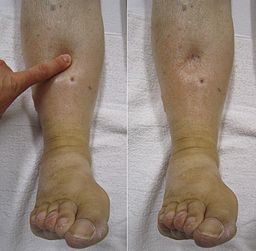
© James Heilman, MD (own work) via Wikimedia Commons
What are the symptoms of swollen legs?
Having 'swollen legs' ist a symptom itself, but legs can be swollen in different ways. The clue to the cause (and therefore the treatment) may well be in the type of swelling. The swelling can be:
One-sided or both-sided. Oedema due to conditions of general body systems is usually on both sides and is symmetrical (for example, if due to heart failure or pregnancy or kidney problems.) One-sided swelling is more likely to be due to a problem with a particular part of that leg.
In a specific area or generalised. Swelling around joints is usually caused by injury or a type of arthritis. Swelling in specific areas of skin may be caused by allergy or infection. Swelling around the back of the heel suggests a problem of the Achilles tendon, etc. Generalised swelling, especially if on both sides, is likely to be oedema.
Painful or painless. Painful conditions include infections, deep vein thrombosis (DVT), injuries and joint problems. Oedema is not usually painful, although legs can ache and feel tight.
Accompanied by red (inflamed) or normal skin colour. If the skin is reddened, it may be due to an infection (such as cellulitis), or inflammation (for example, Gicht, rheumatoide Arthritis or DVT). However if both legs are red then infection as a cause is very unlikely.
Pitting or not. Pitting means that if you press a fingertip into the swollen area and then take your fingertip away, a dent remains in the skin. (See photo earlier in leaflet.) Oedema tends to be pitting. Lymphödem, a condition where there is a blockage to lymph fluid, does not usually pit so much.
Are there any other symptoms?
In addition to the leg or legs being swollen, there may be other associated symptoms. Again, these help give a clue to the cause of the leg swelling. For example:
Breathlessness which started at the same time as the leg swelling might suggest heart failure (if both legs) or DVT (if one leg) spreading to the lungs (pulmonary embolism).
A high temperature (fever) suggests infection.
Tiredness might suggest a more general illness, such as anaemia or kidney problems.
Diarrhoea might suggest a gut problem affecting the amount of protein being absorbed in the guts.
Being yellow (jaundiced) suggests a liver problem, such as Leberzirrhose.
Swelling in other places other than the legs - for example, in the tummy, hands or around the eyes. This would suggest a problem with another or a general body system rather than a problem with the leg or legs.
When to see a doctor for swollen legs
You should see your GP urgently if you:
Think you might have a deep vein thrombosis (DVT). This might be the case if one calf is warm, swollen, red and tender. You might have swelling in the foot of that leg.
Feel out of breath.
Have a high temperature.
Feel generally unwell in yourself.
Are in severe pain.
Notice your skin has turned a yellow colour.
If your legs swell up a little in the hot weather but go down again overnight, you don't need to see a doctor. Or if both ankles are a little puffy after a long flight but there is no pain or redness of the calf, and the puffiness settles quickly then you do not need to see a doctor.
Minor swellings from bites or trivial injuries don't usually need medical attention. In most other situations, it is wise to consult a health professional.
If you have swollen legs and are pregnant, make sure you keep your regular appointment with your midwife. Your midwife will regularly check your blood pressure, and check your wee (urine) for protein to make sure your swollen ankles are not a sign of anything serious.
What tests will be done for swollen legs?
This will depend on the information the doctor has obtained by listening to you and examining you. In some cases, no further tests will be needed. In others, tests will be advised. These might include:
Testing your urine. This can usually be done in the doctor's surgery. The urine is tested with a dipstick to see if there is any protein in it, which might suggest a kidney problem, for example.
Blood tests. You might have blood tests to check you for anaemia or heart failure . Tests may be done to check the function of your kidney, Leber oder thyroid gland.
Eine Truhe X-ray. This would check you for medical conditions such as heart failure or a pulmonary embolism.
Ein Ultraschall-Scan of the leg. This can look at the nature of the swelling and establish where it is coming from. It can be helpful to diagnose tendon problems (such as Achillessehnen-Tendinopathie), DVT and other problems in the veins of the legs.
An X-ray if a fracture or infection of the bone is suspected.
Depending on the results of these tests, other investigations may be needed in some cases.
What is the treatment for swollen legs?
Treatment will be different depending on the cause. If the cause is fluid in the legs (oedema), this can often be relieved in the short term by taking tablets called 'water tablets' (diuretics).
Diuretics increase the amount of fluid that the kidney filters off to be passed in your wee (urine). So when you take diuretics you eventually pee away some of the fluid which was collecting around your legs.
Diuretics are useful when swollen legs occur due to too much fluid in the body (for example, in heart failure). However, when the cause is something else (such as venous insufficiency, which causes fluid to pool in the legs, but not elsewhere in the body), they are usually not helpful, and can potentially cause problems, such as dehydration or kidney issues.
A few examples of some treatments of some common causes are as follows.
DVT is treated with medicines to thin the blood. These help to stop the blood clot from enlarging, and from spreading to the lungs, whilst the body slowly breaks down the clot itself.
Heart failure is usually treated with a number of medications to improve your heart function, including diuretic medicines.
Skin infections (Zellulitis) oder bone infections (osteomyelitis) are treated with Antibiotika.
Where the cause is a medicine, that medicine can usually be changed, or stopped, or the dose reduced.
Sometimes, doctors may recommend wearing compression stockings to reduce swelling of the legs; for example, when venous insufficiency is the cause.
Are there any complications of swollen legs?
This depends on the cause. The most common complication in swollen tissue is infection.
Where the skin is stretched, it is more prone to be dry. If it is dry, it is more prone to breaks in the skin, allowing germs from the outside of the skin underneath. This can result in cellulitis of the legs. If this is the case a large area of the skin of the legs becomes hot and red. It may cause a high temperature (fever).
Patientenauswahl für Schwellung

Anzeichen und Symptome
Lymphödem und Lipödem
Es ist leider sehr häufig, dass die Knöchel gegen Ende eines langen Tages anschwellen – aber was, wenn die Schwellung nicht zurückgeht? Was, wenn auch Ihre Arme betroffen sind? Lymphödem und das seltener auftretende Lipödem könnten die Ursache sein. Wenn Sie Ihren Daumen in einen Bereich des Lymphödems drücken, entsteht normalerweise eine Delle in der Haut. Das passiert beim Lipödem nicht.
von Dr. Hayley Willacy, FRCGP

Anzeichen und Symptome
Idiopathisches Ödem
Idiopathisches Ödem ist der Begriff für Flüssigkeitsansammlungen, die nicht durch eine bekannte medizinische Erkrankung verursacht werden. Es tritt am häufigsten bei Frauen auf und kann sich im Laufe der Zeit verschlechtern. Obwohl es keine Heilung für idiopathisches Ödem gibt, kann eine gesunde, salzarme Ernährung einen echten Unterschied machen. Kompressionsstrümpfe und regelmäßige Bewegung sind ebenfalls vorteilhaft.
von Dr. Colin Tidy, MRCGP
Häufig gestellte Fragen
Warum schwellen meine Beine nachts an?
Wenn Sie an Ödemen leiden, was eine Ansammlung von überschüssiger Flüssigkeit zwischen den Körperzellen ist, führt die Schwerkraft dazu, dass sich diese Flüssigkeit tagsüber in abhängigen Bereichen wie Ihren Beinen ansammelt. Diese Art von Schwellung, genannt 'abhängiges Ödem', verbessert sich typischerweise über Nacht, nachdem Sie Ihre Beine hochgelagert haben.
Können Allergien Schwellungen in den Beinen verursachen?
Ja, Hautreaktionen aufgrund von Allergien, wie eine Reaktion auf einen Biss, einen Stich oder ein Medikament, können dazu führen, dass eines Ihrer Beine anschwillt. Dies wäre typischerweise eine lokale Schwellung in einem bestimmten Hautbereich und nicht ein generalisiertes Ödem.
Verursacht Arthritis geschwollene Beine?
Ja, bestimmte Arten von Arthritis können geschwollene Beine verursachen. Verschleißarthritis, wie Arthrose, kann ein Knie oder beide Knie oder die großen Zehen betreffen. Entzündliche Gelenkprobleme wie Gicht, rheumatoide Arthritis oder Psoriasis-Arthritis können ebenfalls zu Schwellungen führen, oft begleitet davon, dass das betroffene Gelenk warm, rot und schmerzhaft wird.
Was ist Lymphödem?
Lymphödem ist eine Erkrankung, bei der sich Lymphflüssigkeit in den Geweben ansammelt, weil sie nicht richtig abfließen kann. Dieses Problem tritt typischerweise auf, weil die Lymphknoten blockiert sind, was nach einer Operation, Strahlentherapie oder aufgrund von Krebs, Verletzungen oder Infektionen auftreten kann. Im Gegensatz zu normalem Ödem hinterlässt ein Lymphödem normalerweise keine Delle, wenn es gedrückt wird.
Was ist eine Baker-Zyste?
Eine Baker-Zyste ist eine weiche Schwellung, die an der Rückseite Ihres Knies auftreten kann. Sie ist eine der möglichen Ursachen für ein geschwollenes Bein.
Was sind 'Wassertabletten' (Diuretika) und wie helfen sie bei geschwollenen Beinen?
'Wassertabletten' oder Diuretika sind Medikamente, die die Menge an Flüssigkeit erhöhen, die Ihre Nieren herausfiltern, um sie als Urin auszuscheiden. Dies hilft, einen Teil der überschüssigen Flüssigkeit zu entfernen, die sich in Bereichen wie Ihren Beinen angesammelt hat, insbesondere wenn die Schwellung auf zu viel Flüssigkeit im Körper zurückzuführen ist, wie bei Herzinsuffizienz.
Weiterführende Literatur und Referenzen
- Cellulitis - akute; NICE CKS, März 2024 (nur Zugang in Großbritannien)
- Tiefe Venenthrombose; NICE CKS, Juni 2023 (nur UK-Zugang)
- Chronische Herzinsuffizienz bei Erwachsenen – Diagnose und Behandlung; NICE-Leitlinien (September 2018)
Über den AutorVollständige Biografie anzeigen

Dr Mary Harding, MRCGP
Allgemeinmediziner, Medizinischer Autor
BA, MA, MB, BChir, MRCGP, DFFP
Dr. Mary Harding schloss 1989 ihr Medizinstudium an der Universität Cambridge ab.
Über den RezensentenVollständige Biografie anzeigen

Dr Philippa Vincent, MRCGP
Allgemeinmediziner, Medizinischer Autor
MB BS, Bsc, MRCGP (2000), DCH, DFSRH, DRCOG
Dr Philippa Vincent ist ein NHS-Arzt, der in Nordlondon arbeitet.
Artikelverlauf
Die Informationen auf dieser Seite wurden von qualifizierten Klinikern verfasst und begutachtet.
Artikel auch verfügbar in Englisch, Deutsch, Spanisch, Französisch, Italienisch, Portugiesisch, Hindi, Hebräisch, Arabisch, und Schwedisch.
Nächste Überprüfung fällig: 28. Mai 2027
29 May 2024 | Neueste Version
4 Jul 2017 | Ursprünglich veröffentlicht
Verfasst von:
Dr Mary Harding, MRCGP

Fragen, teilen, verbinden.
Durchsuchen Sie Diskussionen, stellen Sie Fragen und teilen Sie Erfahrungen zu Hunderten von Gesundheitsthemen.

Fühlen Sie sich unwohl?
Bewerten Sie Ihre Symptome online kostenlos
Abonnieren Sie den Patienten-Newsletter
Ihre wöchentliche Dosis klarer, vertrauenswürdiger Gesundheitsberatung - geschrieben, um Ihnen zu helfen, sich informiert, selbstbewusst und in Kontrolle zu fühlen.
Durch das Abonnieren akzeptieren Sie unsere Datenschutzrichtlinie. Sie können sich jederzeit abmelden. Wir verkaufen Ihre Daten niemals.
Mehr zu Anzeichen und Symptomen
- Furunkel, Karbunkel und Furunkulose
- Krebssymptome
- Chronische Spannungskopfschmerzen
- Ohnmachtsanfall
- Kopfschmerzen
- Insektenstiche und -bisse
- Gelenkschmerzen
- Verlust von Geschmack und Geruch
- Knoten in der Leiste
- Lymphödem und Lipödem
- Menière-Krankheit
- Beckenschmerzen bei Frauen
- Chronische Rhinitis
- Ameisenlaufen
- Proteinurie
- Schüttelfrost
- Schulterschmerzen
- Steroidinjektionen
- Schwitzende Füße
- Keuchen