Schmerzen im linken Unterbauch
Lower left abdominal pain
Fachlich geprüft von Dr Toni Hazell, FRCGPZuletzt aktualisiert von Dr Philippa Vincent, MRCGPZuletzt aktualisiert 30. März 2026
Entspricht den redaktionellen Richtlinien
- HerunterladenHerunterladen
- Teilen
- Language
- Diskussion
- Audio-Version
- Zu bevorzugten Quellen bei Google hinzufügen
In dieser Serie:Schmerzen im linken Unterbauch während der SchwangerschaftLinksseitige Bauchschmerzen bei Kindern
Schmerzen im linken unteren Quadranten (LLQ) sind Bauchschmerzen, die sich hauptsächlich in der unteren Hälfte auf der linken Seite befinden. Es gibt viele Ursachen für LLQ-Schmerzen.
Wichtige Punkte
Left lower quadrant (LLQ) pain is pain on the left side of your abdomen (tummy), below your belly button.
Common causes include constipation, gastroenteritis, IBS, diverticulitis, and endometriosis. However, there are many other causes.
The treatment for LLQ pain depends on the cause but may include dietary changes, pain relief, and in severe cases surgery.
Wo ist mein linker Unterbauch?
Look down at your abdomen and mentally divide the area from the bottom of your ribs down to your pubic hair into four quarters. The quarter on your left side below your belly button is your left lower quadrant (LLQ).
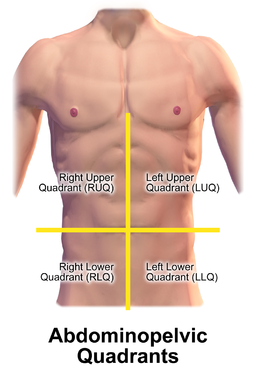
© Von Blausen.com Mitarbeiter (2014). „Medizinische Galerie von Blausen Medical 2014“. WikiJournal of Medicine 1 (2). DOI:10.15347/wjm/2014.010. ISSN 2002-4436
What organs are in my left lower quadrant?
The left lower quadrant contains organs including:
Dünndarm (Ileum).
Teile des Dickdarms (Kolon).
Rektum.
Left ureter.
Left ovary and Fallopian tube in women.
The skin, nerves and blood vessels of that area.
Causes of left lower quadrant pain
There are lots of causes of LLQ pain; they include:
Verstopfung.
Gastroenteritis and food poisoning.
Irritable bowel syndrome (IBS).
Divertikulitis.
Colon and rectal cancer.
Endometriose.
Pelvic inflammatory disease.
Torsion of the testicle.
Verstopfung
Verstopfung can cause discomfort anywhere in your abdomen.
It is caused by poo (stool) backing up in the colon; the discomfort or pain is due to the colon being stretched.
You will often (but not always) be aware that you are not opening your bowels as often as usual.
Your poo will often be hard and pellet-like; sometimes it is painful to pass.
Occasionally (and mainly in children or older adults) there will be loose poo (diarrhoea) because the constipation is higher up and causing a blockage; the poo becomes watery and seeps around the edge of the blockage. This is called "overflow diarrhoea".
Gastroenteritis und Lebensmittelvergiftung
Gastroenteritis, which is usually caused by a virus, is an infection which can cause pain anywhere in your abdomen.
It can also cause diarrhoea, make you feel sick (nausea) or be sick (vomit).
The pain often feels cramping and it may ease for a while each time some diarrhoea is passed.
Food poisoning may be caused by a virus or a bacteria, and has similar symptoms to gastroenteritis. If you think you have food poisoning, a poo test may be sent after 7 days of symptoms to look for particular bacteria.
Reizdarmsyndrom (RDS)
Reizdarmsyndrom (RDS) tends to cause crampy abdominal pains and bloating.
Es kommt und geht und kann mit Durchfall und/oder Verstopfung verbunden sein.
Divertikulitis
Divertikulitis in the last part of the large gut (sigmoid colon) is the most common cause of left lower quadrant (LLQ) pain in adults.
It usually comes with a Temperatur (Fieber) and a change in bowel habit (opening your bowels more or less often than usual for you).
Darmkrebs und Rektumkrebs
Severe LLQ pain, bloating and not being able to open your bowels überhaupt, not even to pass wind (flatus), are symptoms that suggest you may have have a blockage in your bowel . Complete blockage of the bowel is a medical emergency - you should attend A&E.
Darmkrebs and rectal cancer (sometimes called colorectal cancer) are two of the more common cancers in the UK and can cause left lower quadrant (LLQ) pain.
Obwohl Darmkrebs jeden Teil des Dickdarms (Kolon) betreffen kann, betrifft er häufig den letzten Teil (absteigendes Kolon und Sigma), der sich auf der linken Seite befindet. Rektumkrebs betrifft den allerletzten Teil des Dickdarms (Rektum), kurz bevor er am Anus endet.
You may notice changes in how often you open your bowels, a feeling of not fully emptying your rectum, unexplained weight loss or low energy levels, and the presence of blood in your poo.
Eingeklemmter Leisten- oder Schenkelbruch
A left inguinal or femoral hernia does not usually cause much pain but, if it becomes strangulated, it can cause pain in the groin and in the abdomen, usually on the side of the hernia but it may cause pain over the whole abdomen.
Wenn es auf der linken Seite passiert, wird es eine empfindliche Schwellung in der linken Leiste geben.
They occur when a piece of bowel or other tissue from inside the abdomen pushes through a weakness in the muscles of the abdominal wall near the left groin (where the left thigh meets your lower abdomen).
Ursachen von Schmerzen im linken Unterbauch bei Frauen
Ovulation pain (mittelschmerz)
Ovulation is the point at which your ovary releases an egg - this is usually about halfway between two periods.
Mittelschmerz or ovulation pain is when women experience pain when this happens.
Between 1 and 2 in 5 women experience ovulation pain.
It can be severe and last a few minutes or more of a dull pain which lasts a few hours.
It will only be felt on one side, but can be right or left.
You may get similar pain on the same or other side of your abdomen at the same point in another cycle.
Beckenentzündung
Beckenentzündung causes pain that is usually on both sides of the abdomen but can be in the (left lower quadrant) LLQ.
Pain is often worse during sex because the cervix (neck of the womb) is very tender.
You may also have abnormal bleeding, feel generally unwell and feverish, and have smelly vaginal discharge.
Verdrehter Eierstock
Ein verdrehter Eierstock (Ovarialtorsion) tritt normalerweise nur auf, wenn sich eine mit Flüssigkeit gefüllte Zyste am Eierstock entwickelt hat.
Schmerz kann konstant oder intermittierend sein.
Endometriose
Endometriose can sometimes cause constant lower abdominal pain, although usually it is worse just before, during and for a short while after a period.
Pain is usually across the lower part of the abdomen but it can be just on the left side.
Eileiterschwangerschaft
If you are pregnant and having severe pain in your left lower quadrant (or right lower quadrant), this could be an ectopic pregnancy. This is a medical emergency and you should attend A&E urgently .
Eileiterschwangerschaft is a pregnancy that is developing in the Fallopian tube instead of in your womb.
It can cause left lower quadrant pain that is sudden or gradually worsening, and may become severe.
Vaginal bleeding is common but may differ from a normal period (lighter/heavier, darker, or mistaken for a late period). Not everyone who has an ectopic pregnancy has bleeding.
Associated symptoms can include diarrhoea, pain on passing poo, dizziness, faintness, or feeling unwell
Shoulder-tip pain may occur due to internal bleeding irritating the diaphragm.
There is also a separate leaflet called Left lower quadrant pain in pregnancy.
Eierstockkrebs
Manchmal Eierstockkrebs presents with pain or a feeling of pressure in the lower half of the abdomen. This can be on one side or across the whole area.
Women with ovarian cancer may notice bloating.
Ursachen für Schmerzen im linken Unterbauch bei Männern
Any pain coming from the left side of the scrotum can cause pain in the left lower quadrant (LLQ) but usually the pain in the scrotum will be worse than the pain in the abdomen.
Hodentorsion
Torsion of the testicle (testis) is where the testicle twists and the blood supply is cut off.
It causes severe pain in the scrotum and severe lower quadrant pain, usually on one side.
Der Hoden ist sehr empfindlich.
This is a medical emergency and you should attend your nearest A&E immediately.
Epididymo-Orchitis
Epididymo-Orchitis is an inflammation of the testicle and/or the tubes surrounding it (epididymis).
The affected side of the scrotum can swell and become red and tender.
Sometimes epididymo-orchitis causes less severe pain but is usually tender on examination.
Weitere mögliche Ursachen für Schmerzen im linken Unterbauch
Entzündliche Darmerkrankung (IBD): IBD (Morbus Crohn und Colitis ulcerosa) cause the lining of the gut to become inflamed, and this can cause pain in the left lower quadrant (LLQ).
Sigmoidvolvulus: This happens when the very last part of the large bowel, the sigmoid, twists on itself causing a blockage. This causes colicky pain and a severely bloated abdomen. It is dangerous and requires emergency surgery.
Nierensteine: A stone that passes into the ureter draining pee from your right kidney may cause pain that starts in your right loin and spreads to your groin and left lower quadrant (LLQ), or into your testicle if you are a man.
Gürtelrose: A sharp or burning pain may be felt in the abdomen before a rash develops.
Bauchaortenaneurysma: This can cause pain before it bursts. The pain is usually felt in your back or the middle of your abdomen but it can occasionally be felt in the left (or right) lower quadrant.
Referred pain: Pain from your back or hip may be felt around the front into the left (or right) lower quadrant.
Muscle sprains: This can cause pain in your abdomen when you use the pulled or strained muscle to move, cough or laugh.
Wann man einen Arzt aufsuchen sollte
If you have a pain which doesn't settle, you will probably need to consult a health professional to help you figure out the cause.
Konsultieren Sie dringend einen Arzt, wenn Sie:
Habe sehr starke Schmerzen.
Haben Sie anhaltende Übelkeit (Erbrechen).
Haben kürzlich Gewicht verloren, ohne es zu versuchen.
Sich schwindelig, benommen, ohnmächtig oder atemlos fühlen.
Notice blood in your poo or on the toilet paper.
Eine Veränderung Ihrer gewohnten Darmgewohnheiten. Das bedeutet, dass Sie Ihren Darm häufiger oder seltener als gewöhnlich entleeren, was zu Durchfall oder Verstopfung führen kann.
Beachten Sie Blähungen, die sich verschlimmern.
You should urgently attend A&E if you:
Könnte schwanger sein (Sie sollten zuerst einen Schwangerschaftstest aus der Apotheke machen).
Haben Sie starke Schmerzen im Hodensack, die plötzlich oder über einen kurzen Zeitraum hinweg aufgetreten sind.
How is left lower quadrant pain diagnosed?
Your doctor will usually be able to diagnose the cause of your left lower quadrant (LLQ) pain by talking to you to find out about the pain, and examining you.
They will examine your abdomen, including in the area you have the pain. They may sometimes need to examine your bottom (this does not happen in children except by specialists in very rare situations). You may also be asked to provide a sample of pee (urine), to rule out infection.
Women may need an internal examination to rule out or diagnose problems such as pelvic inflammatory disease. Men may need an examination of their scrotum and testicles.
You should always be offered a chaperone for an intimate examination.
Swabs might be taken from women to look for infections such as chlamydia - in men, these are usually tested for by a urine sample.
You may also need blood tests to:
Check the function of your liver and Nieren.
Schließen Sie jegliche Entzündung oder Infektion in Ihrem Körper aus.
Look for Anämie.
Überprüfen Sie Ihren Blutzuckerspiegel.
Weitere Tests
If your doctor is still unsure of the cause of pain, they may recommend further tests such as:
Further blood tests, for example for Zöliakie.
Poo tests to look for blood or inflammation.
Ultraschalluntersuchung - this is particularly used to look at your ovaries and womb if you are a woman, testicles if you are a man, and the bladder and kidneys.
Computertomographie (CT) Scan - this is used to look for diverticula in the bowel, and also to look at your kidneys. Depending on where you live, your GP might be able to organise a CT scan for specific conditions.
Very occasionally, an Röntgenbild may be used to look for constipation - this is mainly in young children where the diagnosis is unclear.
If the answers are still not clear, you may be referred for further tests including:
Koloskopie - this is when a small camera (a scope) is used to check your large bowel.
Sigmoidoskopie - this is when a camera is used to check the lower part of your large bowel.
Magnetresonanztomographie (MRT) - this can be used to look at many of the organs in your abdomen.
Niemand wird all diese Tests benötigen, und manche Menschen benötigen möglicherweise gar keine.
Behandlung von Schmerzen im linken Unterbauch
The treatment for left lower quadrant (LLQ) pain depends on the cause. See the relevant leaflet for the condition with which you have been diagnosed. Treatments for a few of the causes of LLQ pain are briefly discussed below.
Verstopfung. This can be avoided by eating plenty of fruit and vegetables, as well as other foods containing fibre. If your constipation is mild, adding these things to your diet might be enough to treat the constipation. You may be prescribed medication to treat your constipation. Nowadays this is usually with a liquid.
Gastroenteritis and food poisoning. Most people do not need any treatment for this. Small children and elderly adults may become very unwell and need fluids through a drip. It is usually best to avoid medications to try and stop the diarrhoea as this usually makes the symptoms last longer. If the diarrhoea continues for 7 days, a poo test might be done. If this shows a bacteria, then antibiotics might be suggested.
Reizdarmsyndrom. Some people can manage their pain from irritable bowel syndrome by changing their diet and avoiding any "trigger foods". You may be prescribed medication which reduces the spasming of your bowel. These can also be bought over the counter.
Divertikulitis. Diverticulitis causing pain and fever often needs antibiotics to treat it. It can usually be treated with antibiotics by mouth but some people need to be admitted to hospital for antibiotics into a vein.
Colon and rectal cancer. Bowel cancer is often treated with surgery or chemotherapy or both together. The treatment depends on where in the bowel the cancer is and how advanced it is when the cancer is found.
Endometriose. Endometriosis is usually treated with hormones - for example, the oral contraceptive pill. Some women may need different hormonal treatments or surgery; both of these would be provided by a gynaecologist.
Pelvic inflammatory disease. This is treated with antibiotics.
Ectopic pregnancy. This is usually treated with emergency surgery but some women can be treated with a tablet called methotrexate if the pregnancy is very small. A blood test to measure the level of pregnancy hormone in your blood will usually help the doctors to decide which treatment is best for you.
Torsion of the testicle. This is treated with emergency surgery to untwist the testicle. The testicle is usually then "fixed" in place so that it cannot happen again.
Wie ist der Ausblick?
The outlook for left lower quadrant (LLQ) pain depends entirely on the cause of the pain. Some conditions settle very quickly on their own (for example, gastroenteritis), or with the help of antibiotics (for example, a kidney infection). Others can be cured with surgery, such as torsion of the testis.
Some are long-term conditions, such as Crohn's disease or coeliac disease. There is no cure for these conditions but there are treatments which will manage the symptoms.
Your doctor should be able to give you an idea of the outlook (prognosis) once a diagnosis has become clear.
Häufig gestellte Fragen
What causes lower left quadrant pain when breathing or coughing?
Left lower quadrant pain when taking a deep breath in or when coughing will often be due to muscle pain. If it persists more than a few days and you are not aware of having pulled any muscles, or if it is getting worse rather than better, you should seek medical attention.
What causes lower left quadrant pain when walking?
Left lower quadrant pain when walking will often be due to muscle pain. It could also be due to pain from your hip being "referred" into your abdomen. This means that, although the pain is coming from your hip, your brain thinks it is coming from the abdomen. If the pain is getting worse rather than better, you should seek medical attention.
Can kidney infection cause lower left quadrant pain?
A kidney infection can cause pain anywhere along your urinary tract (from your kidney, down your ureter, or in your bladder or your urethra). So this could be anywhere from your loin (just below your ribs), round the side and down to the left lower quadrant (LLQ). However, it would be unusual to have pain in the LLQ only; it would usually be associated with pain in the left loin as well.
Patientenauswahl für Bauchschmerzen

Verdauungsgesundheit
Schmerzen im rechten oberen Quadranten
Schmerzen im rechten oberen Quadranten (RUQ) sind Schmerzen im oberen Teil des Bauches auf der rechten Seite. Es gibt viele Ursachen für RUQ-Schmerzen.
von Dr. Philippa Vincent, MRCGP

Verdauungsgesundheit
Bauchschmerzen
Bauchschmerzen bedeuten Schmerzen im Magen. Normalerweise halten sie nicht lange an und sind oft auf eine Darminfektion oder eine kleine Verstimmung zurückzuführen - es gibt jedoch viele andere mögliche Ursachen. Schmerzen, die stark sind oder sich nicht schnell beruhigen, können die Aufmerksamkeit eines Arztes erfordern.
von Dr. Toni Hazell, FRCGP
Weiterführende Literatur und Referenzen
- Verdacht auf Krebs: Erkennung und Überweisung; NICE-Richtlinie (2015 - zuletzt aktualisiert im April 2026)
Über den AutorVollständige Biografie anzeigen

Dr Philippa Vincent, MRCGP
Allgemeinmediziner, Medizinischer Autor
MB BS, Bsc, MRCGP (2000), DCH, DFSRH, DRCOG
Dr Philippa Vincent ist ein NHS-Arzt, der in Nordlondon arbeitet.
Über den RezensentenVollständige Biografie anzeigen

Dr Toni Hazell, FRCGP
MBBS, BSc, FRCGP, DFSRH, Dip GU med, DRCOG, DCH (London, UK, 2000)
Dr. Toni Hazell hat ihren Abschluss an der St. Mary’s Hospital Medical School gemacht und ihr VTS am Northwick Park Hospital absolviert.
Artikelverlauf
Die Informationen auf dieser Seite wurden von qualifizierten Klinikern verfasst und begutachtet.
Artikel auch verfügbar in Englisch, Deutsch, Spanisch, Französisch, Italienisch, Portugiesisch, Hindi, Hebräisch, Arabisch, und Schwedisch.
30. März 2026 | Neueste Version

Fragen, teilen, verbinden.
Durchsuchen Sie Diskussionen, stellen Sie Fragen und teilen Sie Erfahrungen zu Hunderten von Gesundheitsthemen.

Fühlen Sie sich unwohl?
Bewerten Sie Ihre Symptome online kostenlos
Abonnieren Sie den Patienten-Newsletter
Ihre wöchentliche Dosis klarer, vertrauenswürdiger Gesundheitsberatung - geschrieben, um Ihnen zu helfen, sich informiert, selbstbewusst und in Kontrolle zu fühlen.
Durch das Abonnieren akzeptieren Sie unsere Datenschutzrichtlinie. Sie können sich jederzeit abmelden. Wir verkaufen Ihre Daten niemals.