Penisprobleme, juckender Penis und Penisschmerzen
Begutachtet von Dr Philippa Vincent, MRCGPZuletzt aktualisiert von Dr Doug McKechnie, MRCGPZuletzt aktualisiert 10. Okt. 2024
Erfüllt die Anforderungen des Patienten Richtlinien des Patienten
- HerunterladenHerunterladen
- Teilen
- Language
- Diskussion
- Audio-Version
- Zu bevorzugten Quellen bei Google hinzufügen
In dieser Serie:Vorzeitige EjakulationBalanitisPeyronie-KrankheitPeniskrebsBeschneidungPhimose und Paraphimose
There are a number of penis problems that can result in penis pain, an itchy penis or general penile discomfort. For example, different types of infection or inflammation can cause itch or pain in the penis, such as thrush, herpes, and eczema. Sometimes there are other symptoms, like bumps or ulcers on the penis, or discharge from the penis.
Auf einen Blick
An itchy penis is often caused by a fungal infection like thrush or by balanitis.
Balanitis ist eine Entzündung der Eichel, die auch Schmerzen, Rötungen und Wundsein verursachen kann.
Penisschmerzen können durch Verletzungen, Infektionen oder Erkrankungen wie die Peyronie-Krankheit verursacht werden.
Ausfluss aus dem Penis ist normalerweise auf eine Urethritis zurückzuführen und kann durch sexuell übertragbare Infektionen verursacht werden.
Knoten am Penis können harmlose perlige Papeln oder Genitalwarzen sein.
Die Beschneidung ist ein Eingriff zur Entfernung der Vorhaut, der oft bei Phimose durchgeführt wird.
Erektile Dysfunktion, oder Impotenz, bedeutet Schwierigkeiten, eine Erektion zu bekommen oder aufrechtzuerhalten.
What causes an itchy penis?
An itchy penis is often due to a fungal infection such as Soor. This is also known as candidiasis.
It can be a sign of Diabetes mellitus but this most often has other symptoms too such as:
Müdigkeit.
Excessive thirst.
Needing to pee a lot.
Alternatively, penis itching can sometimes be a symptom of a condition called balanitis. This is the term used to describe inflammation at the head of the penis, which can also cause penis pain.
The tip of the penis may also be:
Red.
Sore.
In addition, you may notice pain when you:
Wee.
Have sex.
Sometimes there is bleeding or a smell coming from your foreskin, which usually develops over a few days.
Balanitis can be caused by poor hygiene and infections picked up during sexual activity or sexual intercourse, such as:
Crabs (public lice).
It can also be caused by infections not linked to sexual activity, such as Soor.
Our separate leaflet on Balanitis has more information.
An itchy foreskin can be caused by posthitis, which means inflammation of the foreskin. This has similar causes and treatment to balanitis.
Things that can result in penile skin itching and affect the shaft of the penis include:
Thrush.
Allergies.
Irritants.
More generalised skin problems such as Psoriasis.
Other skin conditions that can make your penis itch include:
Kontaktekzem (where you come into contact with something you are allergic to, such as soaps or shampoo)
An itchy penis can also sometimes be a cause of a lower urinary tract infection in men (UTI), which can again be a source of penile discomfort and penis pain.
A doctor can often diagnose the condition just by its appearance, but sometimes tests are needed. The treatment depends on the cause.
What causes penis pain?
There are several causes of penis pain which we discuss in more detail below. Causes of penis pain include:
An injury due to a fall or during sports.
Strenuous sexual activity.
Penile fracture - force applied to an erect penis that damages the fibrous part of the shaft. There is no bone in the penis.
Non-sexually transmitted infections, such as yeast infections leading to Balanitis.
A paraphimosis, where the foreskin has been pulled back and gets stuck (this is a medical emergency).
Peyronie-Krankheit
In this condition, thickened areas of scar tissue (fibrous plaques) appear along the shaft of the penis. As a result the penis can develop a bend or assume a deformed shape. The exact cause is unknown but there are several theories. With Peyronie's disease, painful erections and problems with penetration during sex are common.
In most cases tests are not needed, but occasionally a scan is suggested if a blood circulation problem affecting the penis is suspected. The medical treatment includes:
Medication that can be swallowed; or
Medicines applied directly to the surface of the penis; or
Injections into the areas of scarring.
Other treatment options are available. In most cases, the condition stays the same or becomes worse, but occasionally it gets better with time.
See the separate leaflet called Peyronie's disease for additional information.
Hypospadie
Your urethra is the tube running from your bladder down the length of your penis, which your urine comes out of. Hypospadias is a malformation of the urethra and penis that some babies are born with. It can cause difficulties with the urine flow. In later life, there may be erection problems.
There are a number of different forms. In mild cases, the urethra may just open lower down from its usual position. In severe forms, it can open right down at the base of the penis, by the scrotum. Other abnormalities of the foreskin or the underside of the penis may also occur.
Tests are not usually needed unless it is suspected that the abnormalities of the penis are part of a wider disorder (such as 'intersex syndrome'). Treatment may not be needed for milder cases, but many patients require some form of corrective surgery. This is particularly true if there are problems with the direction of urine flow or erection difficulties.
See the separate leaflet called Hypospadias for additional information.
Discharge from the penis
Discharge from the penis is usually caused by inflammation of the urethra. The medical term is urethritis. You may notice a burning pain or urge to pass urine, but this doesn't always happen. Some men don't get any symptoms.
Usually, the cause is a sexually transmitted disease or infection. The common causes are:
Gonorrhoea.
Non-gonococcal urethritis (NGU).
It's more common in younger men, especially men who have sex with men.
As the name suggests, infections other than gonorrhoea can be a cause of NGU.
Chlamydia, a germ (bacterium) is a common cause of NGU. Irritants to the urethra can also be to blame, such as:
Soap.
Spermicides.
Putting a tube (catheter) in to drain the bladder.
Infections causing urethritis usually need treatment to clear. You may still be infectious, even if the symptoms have gone.
If you have a discharge from the penis get checked out by your GP, a sexual health clinic, or a genitourinary medicine (GUM) clinic.
Don't have sex until you and your sexual partner(s) have been tested. Even after treatment, you must avoid sex until it's shown that any infection has been cleared by treatment.
For additional information, see the separate leaflets called:
Lumps on the penis
Many men have tiny bumps around the bottom of the head of the penis. These are called penile pearly papules (see the photo below), and are normal and harmless.
Penile pearly papules
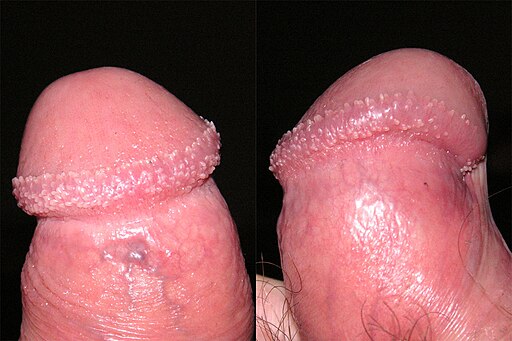
© No machine-readable author provided. Kissekatt assumed (based on copyright claims)., Public domain, via Wikimedia Commons
Another common cause for lumps on the penis is warts, also called Anogenitale Warzen or simply genital warts.
They look like little lumps on the outer skin of the penis.
They also sometimes occur around the anus.
They are caused by infection with the human papillomavirus (HPV).
They are passed on by skin-to-skin contact.
This is mainly during sexual contact, but can occur in other circumstances (eg, from mother to baby during birth).
Warts on the penis usually don't cause any penis pain or symptoms but people seek treatment because of their appearance. It's best to visit a GUM clinic to get checked out for other infections.
Genital warts are not cancers, but some types of HPV can increase the risk of certain cancers, such as:
Anal cancer.
Vulval cancer (in women).
Gebärmutterhalskrebs (in women).
Persistent HPV infection is the leading cause of cervical cancer.
The warts can be left alone, or removed by a variety of methods such as chemicals, freezing, burning, lasers or surgery. New warts develop after treatment in 1 in 4 cases, due to reactivation of the infection.
Condoms - both male and female - help reduce the risk of acquiring genital warts but don't abolish it because of contact with uncovered skin. Sex toys can pass on the virus and should not be shared. A vaccine is now available against HPV infection which is offered to boys and girls aged 12 to 13 years.
See the separate leaflet called Genital warts for additional information.
Beschneidung
This is an operation in which the foreskin is cut off and the remaining skin stitched back. It is usually performed for a condition called phimosis. Phimosis means tightening of the foreskin. This can result in difficulties in pulling the foreskin over the head of the penis and sometimes penis pain.
If the foreskin is pulled back for cleaning or insertion of a tube (catheter) to drain the bladder, and it is not pulled forwards again, the head of the penis (glans) can swell. The foreskin can become trapped under the swollen glans: this is called a paraphimosis. It's not uncommon for this to result in penis pain.
Steroid cream or an operation to loosen the foreskin can sometimes be used if it is not too tight. Otherwise, a circumcision is required.
Sometimes a circumcision is done for religious or hygienic reasons. Other reasons include:
An infection of the glans, called balanitis (see above).
An infection of the foreskin, called posthitis.
A skin condition called balanitis xerotica obliterans.
See the separate leaflet called Circumcision for additional information.
Erektile Dysfunktion
This is also called erectile dysfunction or impotence. There are 2 types of ED:
You can't maintain an erection long enough to complete sexual intercourse; or
You're unable to get an erection at all.
A lot of men have ED now and again, often as a result of stress or tiredness. It can, however, become a more persistent problem. Long-term ED is more likely to happen as you become older.
There are many causes of persistent ED, including:
Circulation problems to the penis.
Diseases of (or injury to) the nerve supply.
Lack of the male hormone (testosterone).
Other causes include:
Recreational drugs.
Radfahren.
Leakage of blood through the veins of the penis.
Psychological causes.
If your ED is due to a circulatory cause (as many cases are) you will need checks to make sure you don't have a more general problem with the state of your circulatory system, including your heart. These may include:
Bluttests to rule out erhöhter Cholesterinspiegel and diabetes.
A Blutdruck check.
Your lifestyle will also be reviewed (eg, Gewicht, Bewegung, rauchen and alcohol intake).
Treatment options will include:
Removing any of the aggravating factors such as excessive alcohol or Stress.
Medication in the form of cream.
Tablets that you swallow.
Injections or pellets put in the urethra.
Other options include:
Vacuum devices
A rod inserted into the penis (a prosthesis).
See the separate leaflet called Erectile dysfunction (Impotence) for additional information.
Peniskrebs
This is also known as penis cancer. It is very rare, affecting 1 in 100,000 men in Europe. A cancerous (malignant) tumour grows from one abnormal cell. It is not known why this happens but certain factors are known to increase the risk. These include:
Age (it is more common over the age of 50).
Becoming infected with the humanes Papillomavirus (HPV).
Certain rare skin conditions (eg, erythroplasia of Queyrat and balanitis xerotica obliterans).
Poor hygiene in adults and having phimosis can increase the risk. Having a Beschneidung as a baby seems to have a protective effect.
The first sign of penile cancer is an alteration in the colour of the skin either:
On the head of the penis (the glans).
Or the underside of the foreskin if you have not been circumcised.
It never occurs on the shaft.
Eventually, the whole of the glans and/or foreskin can become involved.
You will probably need removal of some tissue for analysis (a biopsy) and some scans to confirm the size and spread of the cancer.
Behandlungsoptionen umfassen:
Operation.
Chemotherapy.
See the separate leaflet called Penile cancer for additional information.
Patientenauswahl für Penisstörungen

Männergesundheit
Peyronie-Krankheit
Peyronies Krankheit verursacht einen gekrümmten oder gebogenen Penis. Sie wird durch Narbengewebe entlang des Penis schulter verursacht. Dies führt zu schmerzhaften Erektionen und einer Biegung oder Krümmung, meist etwa in der Mitte des Penis. Die Veränderung der Form ist normalerweise nur sichtbar, wenn der Penis erigiert ist.
von Dr. Doug McKechnie, MRCGP
Männergesundheit
Beschneidung
Die Beschneidung ist ein Eingriff zur Entfernung der Hautfalte, die Vorhaut genannt wird und die Spitze des Penis bedeckt. Die Beschneidung wird hauptsächlich bei Babys und Kleinkindern durchgeführt, kann jedoch in jedem Alter erfolgen. Sie wird sowohl aus medizinischen als auch aus religiösen Gründen durchgeführt. Die Beschneidung ist im NHS nur aus medizinischen Gründen verfügbar. Für religiöse, kulturelle oder ästhetische Gründe muss der Eingriff privat arrangiert werden. Obwohl einige private Kliniken und Anbieter die Beschneidung sicher und hygienisch anbieten, unterliegen sie möglicherweise nicht denselben Standards und Vorschriften wie NHS-Einrichtungen. Bei nicht-medizinischen Beschneidungen könnten Eltern die Risiken und Vorteile abwägen und sich entscheiden, zu warten, bis ihr Kind alt genug ist, um an der Entscheidung teilzunehmen.
von Dr. Mohammad Sharif Razai, MRCGP
Häufig gestellte Fragen
Kann Radfahren erektile Dysfunktion verursachen?
Ja, Radfahren wird als eine der möglichen Ursachen für erektile Dysfunktion (ED) aufgeführt. Wenn Sie unter ED leiden und ein begeisterter Radfahrer sind, könnte dies ein Faktor sein, den Sie in Betracht ziehen und mit einem Arzt besprechen sollten.
Was ist nicht-gonorrhoische Urethritis (NGU)?
Nicht-gonokokkale Urethritis (NGU) ist eine Entzündung der Harnröhre, die nicht durch Gonorrhö verursacht wird. Sie ist eine häufige Ursache für Ausfluss aus dem Penis, insbesondere bei jüngeren Männern. Chlamydien sind eine häufige Ursache für NGU, aber auch andere Reizstoffe wie bestimmte Seifen, Spermizide oder Kathetereinführungen können verantwortlich sein.
Sind perlige Papeln am Penis ein Zeichen einer Infektion?
Nein, perlige Papeln am Penis sind normal und harmlos. Sie erscheinen als winzige Erhebungen um den unteren Rand des Peniskopfes und sind kein Anzeichen für eine Infektion oder ein medizinisches Problem.
Kann ich Sex haben, wenn ich Ausfluss aus meinem Penis habe?
Nein, wenn Sie Ausfluss aus Ihrem Penis haben, ist es wichtig, sexuelle Aktivitäten zu vermeiden. Dies liegt daran, dass der Ausfluss normalerweise durch eine Infektion verursacht wird, oft sexuell übertragbar, und Sie könnten diese an Ihren Partner oder Ihre Partner weitergeben. Sie sollten keinen Sex haben, bis sowohl Sie als auch Ihr(e) Sexualpartner getestet wurden und jede Infektion durch eine Behandlung beseitigt wurde.
Was soll ich tun, wenn ich vermute, Peniskrebs zu haben?
Wenn Sie eine Veränderung der Hautfarbe am Kopf Ihres Penis oder an der Unterseite Ihrer Vorhaut bemerken, ist es wichtig, einen Arzt aufzusuchen. Diese Veränderungen können das erste Anzeichen für Peniskrebs sein, obwohl es sich um eine sehr seltene Erkrankung handelt. Ein Arzt kann Tests wie eine Biopsie durchführen, um die Ursache der Veränderungen festzustellen.
Weiterführende Literatur und Referenzen
- Snodgrass W, Bush N; Recent advances in understanding/management of hypospadias. F1000Prime Rep. 2014 Nov 4;6:101. doi: 10.12703/P6-101. eCollection 2014.
- van der Horst HJ, de Wall LL; Hypospadias, all there is to know. Eur J Pediatr. 2017 Apr;176(4):435-441. doi: 10.1007/s00431-017-2864-5. Epub 2017 Feb 11.
- Peyronie-Krankheit; British Association of Urological Surgeons (BAUS), 2020
- Balanitis; NICE CKS, Mai 2024 (nur Zugang in Großbritannien)
- Penile curvature; European Association of Urology, Sexual and Reproductive Health guidelines, 2023
- European guideline for the management of balanoposthitis; Journal of the European Academy of Dermatology and Venereology, 2022
- Nam JK, Lee DH, Park SW, et al; Clinicopathologic Characteristics and Treatment Outcomes of Penile Cancer. World J Mens Health. 2017 Apr;35(1):28-33. doi: 10.5534/wjmh.2017.35.1.28.
Über den AutorVollständige Biografie anzeigen

Dr Doug McKechnie, MRCGP
Medizinischer Autor
MA, MBBS, MSc, DRCOG, MRCP(UK), MRCGP(2021), FHEA
Dr. Doug McKechnie ist ein NHS-Hausarzt, der in London arbeitet. Er arbeitet klinisch in Vollzeit und ist außerdem stellvertretender Leiter des Moduls für klinische und berufliche Praxis an der University College London Medical School.
Über den RezensentenVollständige Biografie anzeigen

Dr Philippa Vincent, MRCGP
Allgemeinmediziner, Medizinischer Autor
MB BS, Bsc, MRCGP (2000), DCH, DFSRH, DRCOG
Dr Philippa Vincent ist ein NHS-Arzt, der in Nordlondon arbeitet.
Artikelverlauf
Die Informationen auf dieser Seite wurden von qualifizierten Klinikern verfasst und begutachtet.
Artikel auch verfügbar in Englisch, Deutsch, Spanisch, Französisch, Italienisch, Portugiesisch, Hindi, Hebräisch, Arabisch, und Schwedisch.
Nächste Überprüfung fällig: 9. Okt. 2027
10. Okt. 2024 | Neueste Version

Fragen, teilen, verbinden.
Durchsuchen Sie Diskussionen, stellen Sie Fragen und teilen Sie Erfahrungen zu Hunderten von Gesundheitsthemen.

Fühlen Sie sich unwohl?
Bewerten Sie Ihre Symptome online kostenlos
Abonnieren Sie den Patienten-Newsletter
Ihre wöchentliche Dosis klarer, vertrauenswürdiger Gesundheitsberatung - geschrieben, um Ihnen zu helfen, sich informiert, selbstbewusst und in Kontrolle zu fühlen.
Durch das Abonnieren akzeptieren Sie unsere Datenschutzrichtlinie. Sie können sich jederzeit abmelden. Wir verkaufen Ihre Daten niemals.
Mehr zur Männergesundheit
- Akute Prostatitis
- Alpha-Blocker
- Balanitis
- Blut im Sperma
- Brustkrebs bei Männern
- Beschneidung
- Epididymale Zyste
- Epididymo-Orchitis
- Erektile Dysfunktion
- Klinefelter-Syndrom
- Lichen sclerosus
- Niedriger Testosteronspiegel
- Symptome des unteren Harntrakts bei Männern
- Peniskrebs
- Peyronie-Krankheit
- Vorzeitige Ejakulation
- Prostatakrebs
- Soor bei Männern
- Urethritis bei Männern
- Harnverhalt