Eingeschlossene Luft, Gas und Blähungen
Begutachtet von Dr Toni Hazell, FRCGPZuletzt aktualisiert von Dr Hayley Willacy, FRCGP Zuletzt aktualisiert 26. Jan 2026
Erfüllt die Anforderungen des Patienten Richtlinien des Patienten
- HerunterladenHerunterladen
- Teilen
- Language
- Diskussion
- Audio-Version
- Zu bevorzugten Quellen bei Google hinzufügen
Blähungen sind häufig und entstehen, wenn sich Gas im Magen oder Darm ansammelt, was zu Völlegefühl, Aufstoßen oder Blähungen führt. Jeder hat eine gewisse Menge Gas im Darm, aber bei manchen Menschen wird eine größere Menge Gas produziert.
Siehe auch das separate Merkblatt mit dem Titel Bauchschmerzen.
Wichtige Punkte
Gefangene Luft entsteht, wenn sich Gas im Magen oder Darm ansammelt und nicht leicht entweichen kann. Es verursacht Blähungen, scharfe oder krampfartige Bauchschmerzen, Aufstoßen und Blähungen.
Viele Dinge können Blähungen verursachen, darunter das Schlucken von Luft, bestimmte Lebensmittel und Getränke wie Bohnen, Kohl und kohlensäurehaltige Getränke, Verstopfung oder Verdauungsstörungen wie IBS.
Gefangene Luft kann durch sanfte Bewegung, Aufstoßen, Furzen, Änderungen in der Ernährung und rezeptfreie Medikamente wie Simeticon gelindert werden.
If pain is severe, constant, or comes with unexplained weight loss, vomiting blood, or other worrying symptoms, you should seek medical help immediately.
Was ist eingeschlossene Luft?
Trapped wind is also called Gas oder Blähungen. Es ist die Ansammlung von Luft oder Gas in Ihrem Darm (Verdauungssystem), die sich nicht leicht durchbewegt. Es kann im oberen oder unteren Darm eingeschlossen werden, was zu unangenehmen Empfindungen führt. Nach einiger Zeit wird es als Aufstoßen (oberer Darm) oder Furzen (unterer Darm) freigesetzt.
Dies ist äußerst häufig und die meisten Menschen tun es irgendwann in ihrem Leben. Menschen können es mehr als andere erleben, wenn sie dazu neigen, ängstlich zu sein und besorgnisbedingte Magen-Darm-Symptome haben oder am Reizdarmsyndrom leiden.
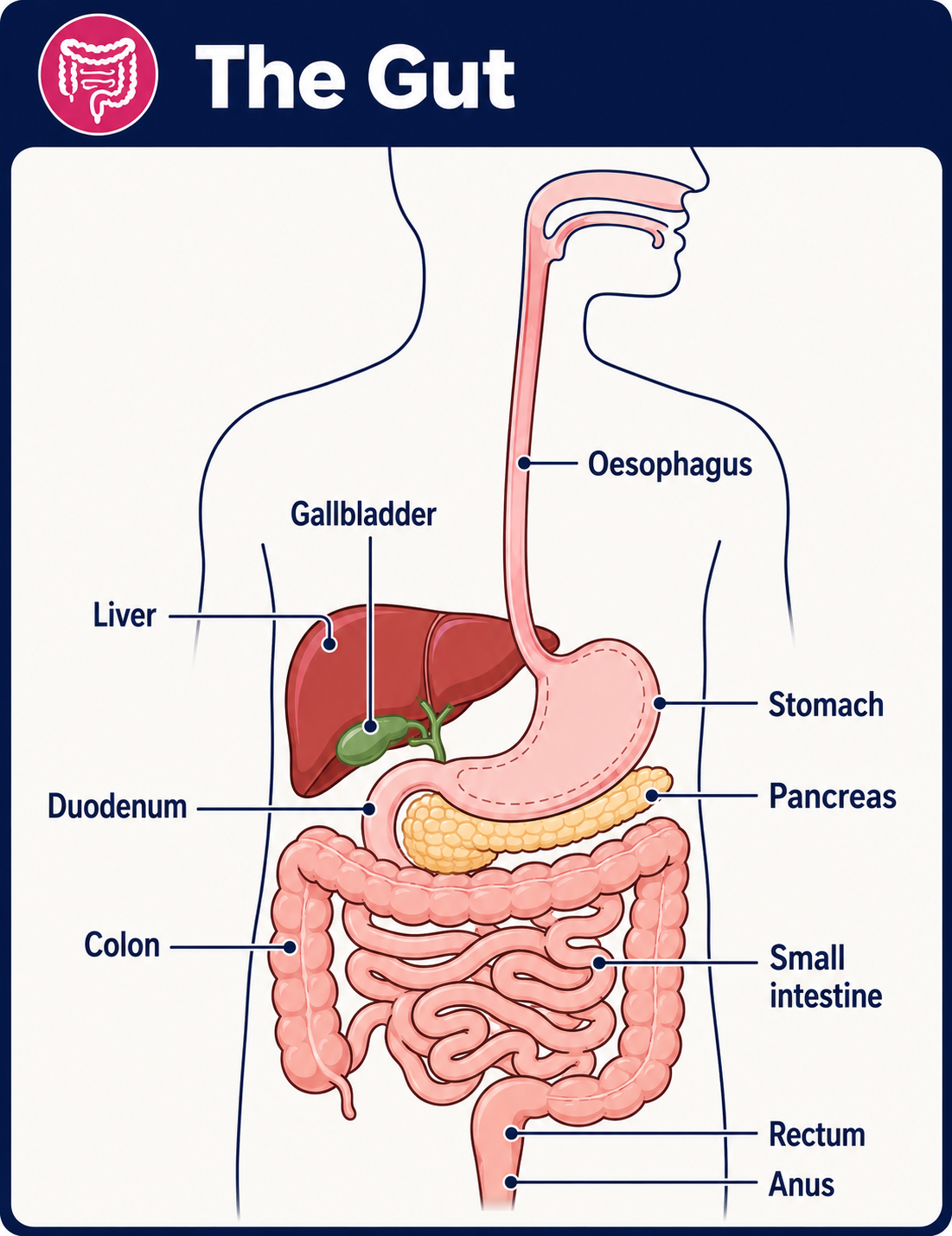
Diagramm zur Benennung der Teile des Darms
Wie wird Gas produziert?
Gas in the bowel is produced by swallowed air and by bacteria breaking down food in the gut.
Air is taken in while eating, drinking, chewing gum, smoking, or swallowing saliva, and swallowing larger amounts - especially when eating quickly. This can lead to bloating as this air travels through the oesophagus and into the stomach.
Aufrechtes Sitzen führt oft dazu, dass diese Luft als Rülpser entweicht, während flaches Liegen sie nach unten drücken kann, was Bauchdruck erzeugt, bevor sie in den Dünndarm gelangt und als Blähungen austritt.
Gas wird auch produziert, wenn Darmbakterien bestimmte Lebensmittel wie Brokkoli, Rosenkohl und Bohnen verdauen, wobei Kohlendioxid, Wasserstoff, Methan und kleine Mengen Schwefel entstehen, die den unangenehmen Geruch verursachen. Diese Gasansammlung kann zu einem aufgeblähten Bauch führen, wodurch sich der Magen eng, geschwollen und unangenehm anfühlt.
Trapped wind symptoms
Symptome von eingeschlossener Luft umfassen:
Krämpfe im Bauch.
Aufgeblähter Bauch.
Schmerzen im Oberbauch.
Schmerzen im oberen oder unteren Rücken.
Gurgelnde Geräusche.
Sich voll fühlen.
Mehr rülpsen oder furzen.
Gas sammelt sich manchmal in den Krümmungen des Dickdarms (Grimmdarm) unter der Leber oder Milz. Dies kann Schmerzen im oberen rechten oder oberen linken Bereich Ihres Bauches verursachen.
Die Symptome von eingeschlossener Luft können beunruhigend sein, da sie sich schwerwiegender anfühlen können, als sie tatsächlich sind. In den meisten Fällen ist eingeschlossene Luft jedoch harmlos und beruhigt sich normalerweise, sobald das Gas durch das System geleitet wird.
Was kann mit eingeschlossener Luft verwechselt werden?
Die häufigsten Beschwerden, die Blähungen ähneln, sind:
Verstopfung - this can cause bloating and pain that usually improves after opening your bowels.
Verdauungsstörungen - this can cause pressure in the upper part of your tummy, as well as belching and a burning feeling.
Reizdarmsyndrom (RDS) - this can cause recurrent bloating and pain relieved by passing poo (stool) or wind.
Nahrungsmittelunverträglichkeiten (such as lactose or gluten sensitivity) - these can create a lot of gas, as well as colicky pain (that comes and goes), diarrhoea or constipation.
Gastritis oder saurer Reflux - this can cause discomfort in your upper abdomen or chest, and a sensation of fullness.
What causes trapped wind?
Blähungen entstehen, wenn sich zu viel Gas in Ihrem Verdauungssystem befindet. Gründe, warum Sie möglicherweise mehr Gas im Bauch haben als normal, sind unter anderem die folgenden:
Zuviel Luft schlucken (aerophagia) - by eating and drinking too quickly, chewing gum, smoking, fizzy drinks, and from stress.
Ernährung - Verzehr von Lebensmitteln mit hohem Ballaststoffgehalt (Brokkoli, Rosenkohl, Bohnen, Obst), stärkehaltigen Lebensmitteln (Kartoffeln, Mais und Nudeln) und Laktosezucker (Milch, Käse, Eiscreme und verarbeitete Lebensmittel).
Digestive issues - conditions such as Laktoseintoleranz, fructose intolerance, Reizdarmsyndrom (RDS),
Erkrankungen des Darms - wie zum Beispiel Zöliakie, entzündliche Darmerkrankungen (Colitis ulcerosa und Morbus Crohn).
Medikamente - some medicines such as Metformin (a medicine for diabetes), Lactulose (a laxative), and Antazida wie zum Beispiel Magnesiumtrisilicat can cause gas and bloating as a side effect.
Infektionen - wie zum Beispiel Gastroenteritis (Magen-Darm-Infekt), Giardiasis, und Divertikulitis.
Andere Darmprobleme - wie zum Beispiel Kurzdarmsyndrom, dünndarmbakterienüberwucherung (SIBO), und Sklerodermie.
Do I need any tests for trapped wind or bloating?
Die meisten Menschen mit diesen Symptomen benötigen keine Tests. Sie könnten jedoch Tests benötigen, wenn Sie besorgniserregendere Symptome haben. Diese können umfassen:
Die Tests können umfassen:
Eine Stuhlprobe to check for blood, high levels of fat (which could suggest problems with food absorption) and infection.
Ein Laktosetoleranztest.
Untersuchung Ihres Magens oder Dickdarms mit einer Kamera (Endoskopie).
A Bluttest auf Zöliakie.
Wie man eingeschlossene Winde loswird
There are several Hausmittel that you can try that help relieve trapped wind and Blähungen zu stoppen. Dazu gehören:
Änderungen an Ihrer Ernährung vornehmen
Some foods are well known for making you bloated. Cut down on these triggers.
If you are unsure of what triggers you, keep a record of the foods and drinks you have and drink to see if there are any foods or beverages which could be associated with your symptoms. These can include milk and milk products, certain fruits and vegetables, whole grains, artificial sweeteners, and fizzy drinks. Pulses, bran, and fruit contain fermentable carbohydrates, sugars which are easily broken down by the digestive system.
Wenn Sie laktoseintolerant sind, müssen Sie laktosehaltige Lebensmittel meiden. Sprechen Sie mit Ihrem Arzt, um herauszufinden, wie Sie dies am besten tun können, ohne Komplikationen wie Kalzium- und Mineralstoffmangel zu entwickeln.
Wenn Sie fructoseintolerant sind, sollten Sie fructosehaltige Lebensmittel vermeiden. Fructose wird als Süßstoff in vielen verarbeiteten Lebensmitteln verwendet; achten Sie auf 'hoher Fructosegehalt in Maissirup' auf dem Etikett.
Lebende Mikroorganismen (Probiotika) können hilfreich sein, obwohl die Beweise nicht schlüssig sind. Probiotika sind 'darmfreundliche' Keime (Bakterien) wie Lactobazillen und Bifidobakterien. Der spezifische Bakterienstamm kann wichtig sein, aber nach aktuellem Stand der Beweise ist es schwierig zu empfehlen, welchen Stamm/welche Stämme man verwenden sollte.
Diäten, die Verstopfung bekämpfen, können hilfreich sein. Zum Beispiel wird lösliche Ballaststoffe wie Leinsamen (bis zu einem Esslöffel täglich) und Hafer empfohlen.
Regelmäßige Bewegung
Es wurde gezeigt, dass Bewegung gasbedingte Symptome verbessert. Dies liegt teilweise an der aufrechten Position, da das flache Liegen dazu neigt, die Bewegung von Gasen im Körper zu stoppen.
Ein 15-minütiger gemütlicher Spaziergang nach dem Essen.
Yoga poses such as wind-relieving pose (pawanmuktasana), cat-cow stretch, seated twists, and child's pose.
Beckenkippung. Diese Bewegung hilft, Druck und Unbehagen im Unterbauch zu lindern und fördert die Bewegung von Gasen.
Legen Sie sich auf den Rücken, die Knie gebeugt und die Füße flach auf den Boden.
Spannen Sie Ihren Bauch an und kippen Sie Ihr Becken leicht nach oben, sodass Ihr unterer Rücken flach auf dem Boden liegt.
Halten Sie 5-10 Sekunden lang, dann entspannen.
5-10 Mal wiederholen.
Breathe deeply during all exercises. Deep breathing can help reduce tension and stimulate digestion.
Einnahme von rezeptfreien Medikamenten
Einige rezeptfreie Medikamente können helfen, Blähungen zu lindern, dazu gehören:
Simeticon for bloating. It is usually sold in combination with an antacid. Simeticone is also used for Koliken bei Babys und Kleinkindern. Simeticon hat sich bei Blähungen im Zusammenhang mit dem Reizdarmsyndrom als nicht hilfreich erwiesen.
Medicines which encourage the movement of the gut (prokinetic medicines). They can be quite helpful as bloated stomach remedies if you have excessive belching and bloating. Most of these are prescription-only preparations but Pfefferminze can be bought in various forms.
Medicines which relieve spasm may also be helpful for bloating and distension. Medicines in this group, available without prescription, include Mebeverin und alverin.
Psychologische Therapien
Psychological therapies such as Achtsamkeit und kognitive Verhaltenstherapie (CBT) may be useful for people who have a low tolerance to a normal amount of gas in the stomach.
Sie können auch hilfreich für Menschen sein, die unter übermäßigem Aufstoßen leiden, insbesondere wenn Aerophagie die Ursache ist. Aerophagie kann manchmal auch durch einen Logopäden behandelt werden.
Deodorierende Produkte
Kohlefaser-Unterwäsche scheint effektiv zu sein, ist aber teuer. Holzkohle-Pads und -Kissen sind günstiger, aber möglicherweise nicht so effektiv.
When to see a doctor for trapped wind
Trapped wind pain is höchstwahrscheinlich to:
Kommen und gehen in Wellen.
Bewegen Sie sich um den Bauch herum.
Verbessern Sie sich durch Blähungen, Stuhlgang, Bewegung oder Wärme.
Treten ohne Fieber oder andere (nicht-darmbezogene) Krankheitssymptome auf.
So suchen Sie dringend medizinische Hilfe if pain is:
Schwer, konstant oder sich verschlechternd.
Auf einen Punkt lokalisiert.
Begleitet von Fieber, Erbrechen, Ohnmacht, Brustschmerzen oder Atemnot.
Und geh bald zum Arzt to discuss pain which is:
Verknüpft mit Blut im Stuhl oder unerklärlichem Gewichtsverlust.
Wie man Blähungen vorbeugt
Preventing trapped wind mostly comes down to wie Sie essen, was Sie essen und wie sich Ihr Darm bewegt.
Anders essen und trinken
Langsam essen und gut kauen (weniger verschluckte Luft).
Vermeiden Sie es, beim Kauen zu sprechen.
Überspringen Sie keine Mahlzeiten, um später nicht zu viel zu essen.
Reduzieren Sie kohlensäurehaltige Getränke, Bier und Sprudelwasser.
Vermeiden Sie das Trinken durch Strohhalme und das Kauen von Kaugummi.
Passen Sie Ihre Ernährung an
Häufige blähende Lebensmittel (Sie müssen nicht alle vermeiden - sehen Sie, wie sie auf Sie wirken):
Bohnen und Linsen.
Zwiebeln, Kohl, Brokkoli, Blumenkohl.
Künstliche Süßstoffe (wie Sorbit, Xylit).
Große Mengen an Milchprodukten (bei Laktoseintoleranz).
Hilfreiche Tipps:
Führen Sie Ballaststoffe allmählich ein, nicht plötzlich.
Ballaststoffe mit ausreichend Wasser ausgleichen.
Versuchen Sie, ein Ernährungs-Symptom-Tagebuch zu führen für 1-2 Wochen.
If symptoms are frequent, kann eine Low-FODMAP-Diät (guided by a health professional) might help.
Halten Sie Ihren Darm in Bewegung
Regelmäßige körperliche Aktivität (ein 10-15 minütiger Spaziergang nach den Mahlzeiten).
Ignorieren Sie nicht den Drang, Ihren Darm zu entleeren.
Regelmäßige Toilettengewohnheiten beibehalten.
Verstopfung frühzeitig behandeln.
Reduzieren Sie die Darmspannung
Der Darm ist empfindlich gegenüber Stress:
Üben Sie langsames Atmen oder Entspannungstechniken.
Machen Sie sanftes Yoga oder Dehnübungen (Knie-zur-Brust, Drehungen).
Versuchen Sie, ausreichend Schlaf zu bekommen.
Häufig gestellte Fragen
Wie lange kann eingeschlossene Luft anhalten?
Blähungen verschwinden normalerweise innerhalb weniger Stunden, aber in einigen Fällen können sie ein oder zwei Tage anhalten. Sie sollten einen Arzt aufsuchen, wenn Ihre Symptome anhalten oder sich verschlimmern.
Können Sie eingeschlossene Gase freisetzen, indem Sie auf Ihren Bauch drücken?
Massaging your stomach can help move trapped gas and relieve pain. Starting at the lower right side of your stomach, gently massage the area in a circular motion, moving up, across to the left, and then down, following the natural path of your intestines.
Welche Schlafposition lindert Blähungen?
Auf der linken Seite liegen mit leicht gebeugten Knien kann helfen, eingeschlossene Luft durch den Darm zu bewegen und Beschwerden während des Schlafens zu lindern.
Hilft das Trinken von heißem Wasser gegen Blähungen?
Ja, heißes Wasser zu trinken kann einigen Menschen helfen, eingeschlossene Winde zu lösen. Warmes Wasser kann die Muskeln im Darm entspannen, die Bewegung durch das Verdauungssystem fördern und es erleichtern, dass Gase entweichen.
Patientenauswahl für Allgemeine Anzeichen und Symptome

Anzeichen und Symptome
Beckenschmerzen bei Frauen
Pelvic pain is more common in women. There are many different causes of pain in your pelvic area. They can be separated by when they tend to happen, if you are pregnant and if they are accompanied by other symptoms such as vaginal bleeding. The most common causes are mentioned below. Most will improve with painkillers. Most recurring causes have treatments available.
von Dr. Hayley Willacy, FRCGP

Anzeichen und Symptome
Juckreiz
Dieses Merkblatt gibt einen kurzen Überblick über Juckreiz, wenn keine Ursache für den Juckreiz gefunden werden kann. Verschiedene andere Merkblätter behandeln Zustände, bei denen die Ursache des Juckreizes bekannt ist, wie Ekzeme oder Urtikaria.
von Dr. Rosalyn Adleman, MRCGP
Weiterführende Literatur und Referenzen
- Moshiree B, Drossman D, Shaukat A; AGA Klinische Praxisaktualisierung zur Bewertung und Behandlung von Aufstoßen, Bauchblähungen und -aufblähungen: Expertenbewertung. Gastroenterologie. 2023 Sep;165(3):791-800
- Pessarelli T, Sorge A, Elli L, Costantino A; Die Low-FODMAP-Diät und die glutenfreie Diät bei der Behandlung von funktionellem abdominalem Blähbauch und Distension. Front Nutr. 2022 Nov 8;9:1007716
- Lacy BE, Gabbard SL, Crowell MD; Pathophysiologie, Bewertung und Behandlung von Blähungen: Hoffnung, Hype oder heiße Luft? Gastroenterol Hepatol (N Y). 2011 Nov;7(11):729-39.
- Bendezu RA, Barba E, Burri E, et al; Darmgasgehalt und -verteilung bei Gesundheit und bei Patienten mit funktionellen Darmbeschwerden. Neurogastroenterol Motil. 2015 Sep;27(9):1249-57. doi: 10.1111/nmo.12618. Epub 2015 Jun 21.
- Bendezu RA, Mego M, Monclus E, et al; Koloninhalt: Einfluss von Ernährung, Mahlzeiten und Defäkation. Neurogastroenterol Motil. 2017 Feb;29(2). doi: 10.1111/nmo.12930. Epub 2016 Aug 21.
Über den AutorVollständige Biografie anzeigen

Dr Hayley Willacy, FRCGP
Allgemeinmediziner, Medizinischer Autor
MBChB (1992), DRCOG, DFFP, MRCOG (Part 1) MRCGP (2007), DFSRH (2013), MSc - medical education (2020)
Dr. Hayley Willacy war eine NHS-Hausärztin, die in Nordwestengland arbeitete und 2022 nach 30 Jahren aus der klinischen Praxis ausschied.
Über den RezensentenVollständige Biografie anzeigen

Dr Toni Hazell, FRCGP
MBBS, BSc, FRCGP, DFSRH, Dip GU med, DRCOG, DCH (London, UK, 2000)
Dr. Toni Hazell hat ihren Abschluss an der St. Mary’s Hospital Medical School gemacht und ihr VTS am Northwick Park Hospital absolviert.
Artikelverlauf
Die Informationen auf dieser Seite wurden von qualifizierten Klinikern verfasst und begutachtet.
Artikel auch verfügbar in Englisch, Deutsch, Spanisch, Französisch, Italienisch, Portugiesisch, Hindi, Hebräisch, Arabisch, und Schwedisch.
Nächste Überprüfung fällig: 26. Juli 2030
26. Jan 2026 | Neueste Version

Fragen, teilen, verbinden.
Durchsuchen Sie Diskussionen, stellen Sie Fragen und teilen Sie Erfahrungen zu Hunderten von Gesundheitsthemen.

Fühlen Sie sich unwohl?
Bewerten Sie Ihre Symptome online kostenlos
Abonnieren Sie den Patienten-Newsletter
Ihre wöchentliche Dosis klarer, vertrauenswürdiger Gesundheitsberatung - geschrieben, um Ihnen zu helfen, sich informiert, selbstbewusst und in Kontrolle zu fühlen.
Durch das Abonnieren akzeptieren Sie unsere Datenschutzrichtlinie. Sie können sich jederzeit abmelden. Wir verkaufen Ihre Daten niemals.
Mehr zu Anzeichen und Symptomen
- Abdominalmassen
- Achalasie
- Atembeschwerden bei Kindern
- Chronische Spannungskopfschmerzen
- Dehydrierung
- Epworth-Schläfrigkeitsskala
- Fieber bei Kindern
- Kopfschmerzen
- Verlust von Geschmack und Geruch
- Symptome des unteren Harntrakts bei Männern
- Symptome des unteren Harntrakts bei Frauen
- Knoten in der Leiste
- Übelkeit und Erbrechen
- Nächtliches Schwitzen
- Ameisenlaufen
- Proteinurie
- Skrotale Knoten, Schmerzen und Schwellungen
- Harnröhrenstriktur
- Schwindel
- Bluterbrechen